
The anti-Cinema Paradiso: Habibi Hussein, or the forked tongue of the West
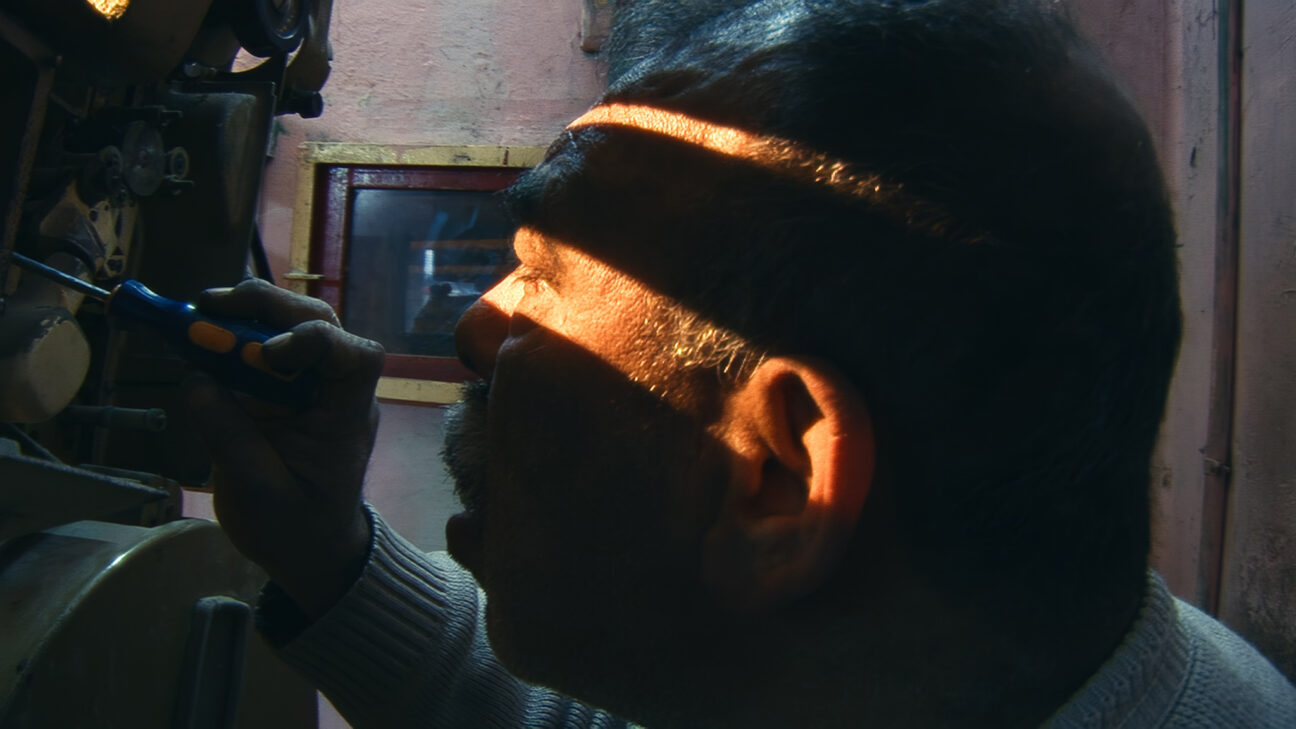
Habibi Hussein functions as an unofficial behind-the-scenes of Marcus Vetter’s 2012 documentary Cinema Jenin. In it, Vetter’s own cinematographer exposes the Western project of restoring a dilapidated cinema on the West Bank as a neocolonial nightmare for its old projectionist.
In 2012, German director Marcus Vetter releases his documentary, Cinema Jenin, about a project he initiated to restore a derelict cinema in Jenin, located on the Palestinian West Bank.
Fourteen years later, his cinematographer at the time, Palestinian filmmaker Alex Bakri (editor of Oscar-nominated German-Syrian documentary Of Fathers and Sons, 2017), edits his own version of events from what must have been a vast amount of footage. So much footage, in fact, that even this leftover material often provides two, even three camera angles for a single scene. The result, Habibi Hussein (Palestine/Germany/Saudi Arabia, 2025), is an impressively comprehensive and cinematic documentary which was never meant to be. It raises the very real question of how many other standalone films could still be edited out of the discarded materials of completed documentaries.
The story Bakri tells is very different from Vetter’s.
The latter’s whole set-up contains a beautiful irony: a Western NGO goes to Palestine, decides to work with Palestinian people out of some theoretical sense of local ownership, then seemingly inevitably defaults to cultural neocolonialism, only to be exposed by the same local cinematographer they had hired to document their project.
It is painful to watch.
As a white, Germanic cinephile and a lover of old cinemas, it is easy for me to identify with Vetter. And even more so with the young, enthusiastic German staff he brings in to assist him—because, as much as Vetter keeps insisting to the media that everything which can be done locally will be done locally, within no time a whole German battalion of workers, architects, and technicians has invaded the premises. They come to very explicitly do it their own, German way.
If I’d met some of these presumably idealistic Germans in a bar in Berlin, I would probably have gotten along with them just fine, which makes Bakri’s exposé even more confronting. Were I to join these workers in restoring the old cinema, would I have been more aware of the bigger picture than they were? Or would I have acted exactly the same, thereby completely ignoring, undervaluing and ultimately sidelining Bakri’s main character, Hussein Darby?
Maybe this review, like the cinema in Jenin, should have been left to a Palestinian colleague. But this is a FIPRESCI jury report from the Golden Apricot International Film Festival in Yerevan, Armenia, and I was on the jury, so let’s continue.
Hussein Darby is the old projectionist of Cinema Jenin. Although the cinema has stood empty for decades, he is still around, still trying to keep his projectors running, still hoping for the day his cinema will once again be filled with enchanted audiences. When he sees the German NGO arrive, at first he seems rather optimistic. Here, after all, might be a real opportunity for him to realise his dream. A dream which inevitably recalls Italian filmmaker Giuseppe Tornatore’s unbeatable 1989 classic Cinema Paradiso.
But Hussein’s story turns in the opposite direction. It’s the anti-Cinema Paradiso. Tornatore calmly centres and romanticises his main character, the elderly projectionist irresistibly portrayed by French actor Philippe Noiret. Conversely, Hussein, although repeatedly and seemingly affectionately called “habibi” by the Germans, is quite violently marginalised, belittled, and then replaced by condescending young German projectionist Franz.
Imagine a group of Palestinians taking over Noiret’s cinema in Cinema Paradiso, bringing in their own equipment, their own architects, and their own ideas about what should be screened—and then sending Noiret’s character packing. It would have been a very different film. Instead of warm fuzzy feelings, we would have ended up with stomachaches, which is what I felt while watching Habibi Hussein.
Hussein Darby is a fantastic lead. He could be called naïve in assuming that he would, of course, regain his former occupation as chief projectionist of Cinema Jenin and be the instructor of the younger generation following in his footsteps. However, the only reason this is naïve is because the world is as it is. In a world more sensible and equitable, his dream is exactly what would happen.
Admittedly, at first glance, Hussein might seem a little absent-minded and even stubborn. His mouth is always a bit open, his posture is hunched, and he walks more or less like Chaplin—as if the old movies he has been projecting for ages have slowly seeped into his body. Sometimes, he seems to freeze and just stares. It’s quite clear that the German team doesn’t expect much from him. But appearances, as always, are deceiving: put Hussein near a faulty projector and he will stare, he will think, and he will fix it. It doesn’t matter how many people he will have to visit and convince to lend (which means: give) him that one specific component he needs.
These are moments where we, as the enchanted audience, can root for Hussein and see him triumph. But ultimately, nothing Hussein does has any effect on the outcome. The way Bakri tells it, from the moment the German team entered the cinema building, his fate was sealed. At the end of the documentary, as local dignitaries attend the reopening of Cinema Jenin (which would be demolished a few years later to make way for a shopping mall), Hussein is the only one who doesn’t receive the framed certificates handed out to all participants.
Kees Driessen
Edited by Olivia Popp
©FIPRESCI2026