
In Vino Veritas: Searching for Truth in The Ballad from Wednesday to Thursday
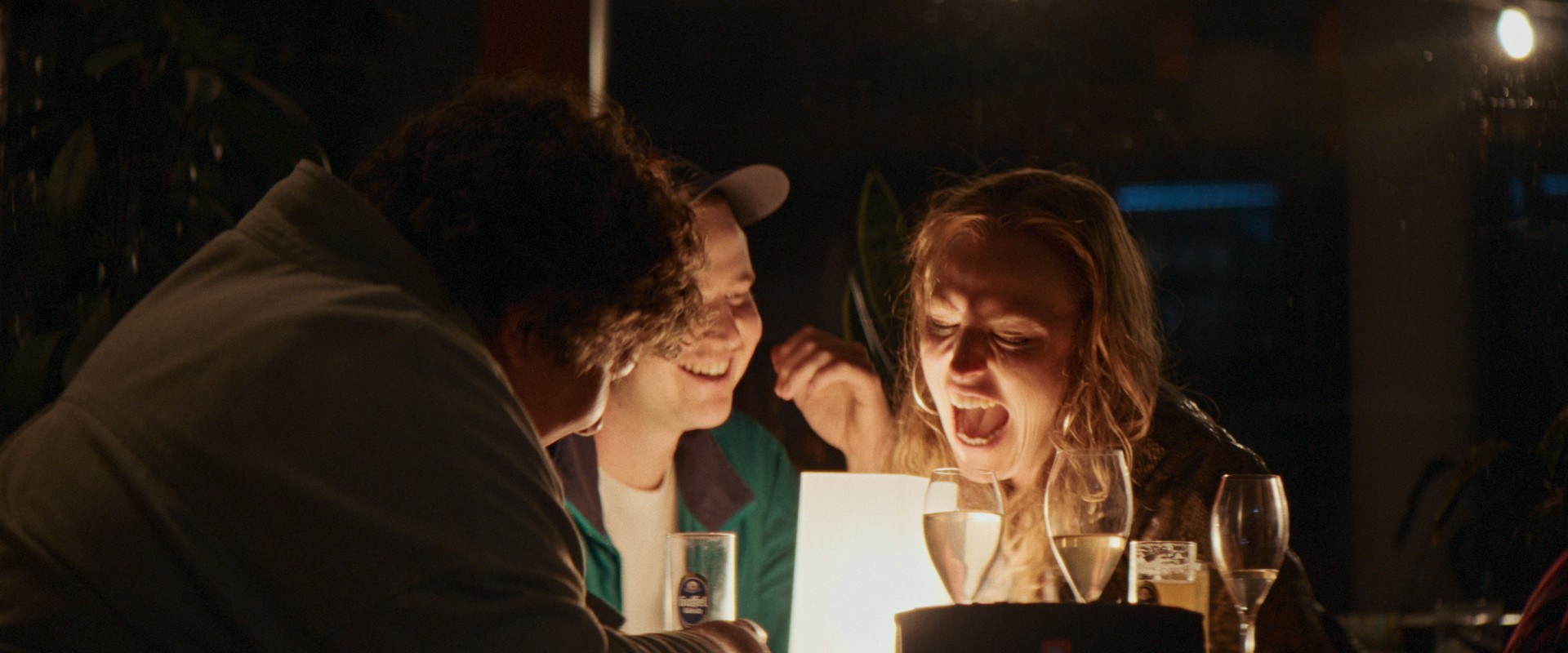
The seemingly naïve question, “What is a bar?”, can be answered in various ways. A bar is, of course, a place for drinking alcohol and other beverages, but it is also a place of encounters, both ordinary and significant. In that sense, it becomes the epicentre of local life and, on another level, a metaphor for society itself. The microcosm of a bar encapsulates social tensions, human aspirations, disappointments, and everyday rituals. It functions as a barometer of the world surrounding it—a phenomenon that German director Christoph Otto explores in The Ballad from Wednesday to Thursday (Die Ballade von Mittwoch auf Donnerstag), one of the most intriguing films screened at the 43rd Munich FilmFest.
Like an opera buffa, the film draws viewers into a grotesque world that gradually reveals itself to be an unsettling reflection of their own reality. As in Gogol, we find ourselves laughing at human folly—only to realise that the joke is ultimately on us. “In vino veritas,” says the familiar Latin maxim. But what does truth mean today? And what has become of words such as “democracy,” so frequently invoked yet so endlessly manipulated? Otto poses these questions without offering easy answers.
The film is built upon recognisable social archetypes. There is an elderly woman struggling with depression; a middle-class couple who spend their evenings playing cards; a lonely gay man searching for companionship; a middle-aged regular whose far-right opinions grow louder with every beer; second- and third-generation Muslim immigrants; young women seeking either fleeting romance or lasting love; and a young intellectual, probably descended from Middle Eastern refugees, who quietly resists the increasingly direct advances of a German policewoman. Cultural difference repeatedly proves difficult to overcome.
For the descendants of immigrants, questions of identity become particularly pressing. While many Germans continue to view newcomers with unease, immigrants and their children often experience an equally painful uncertainty, unsure where they truly belong or which values should define them. In this sense, The Ballad from Wednesday to Thursday is also a film about identity—national, cultural, and personal—and about the crisis that accompanies its constant renegotiation. Cultural diversity is presented as a source of enormous richness, but also as a challenge that demands continuous self-definition.
Otto’s film offers a cross-section of contemporary German society. Conspicuously absent are representatives of the social elite, who presumably seek refuge not in neighbourhood bars but in expensive restaurants or solitary evenings before the television. Yet loneliness transcends class. In an age increasingly shaped by individualism and self-absorption, belonging to a community is often perceived as a threat to personal freedom.
For Otto, however, community represents salvation. The bar becomes a surrogate family, offering security, belonging, and acceptance—the elements of what psychologists often describe as the fundamental conditions for emotional well-being. Within this modest social space, relationships emerge that might never develop elsewhere. Friendships are formed, romances begin, and conversations unfold—about loneliness, disappointment, everyday existence, and, inevitably, about Germany itself.
Germany remains the film’s central concern. It is simultaneously a source of anxiety and an object of profound, if often unrequited, affection. “Who are contemporary Germans? Who are we really?” Otto seems to ask. His ensemble narrative provides a framework for examining immigration, social welfare, cultural integration, fractured families, and the broader crisis of national identity. The differing opinions expressed by his characters emerge naturally from their personal histories, creating a small-scale portrait of democracy itself.
But what does democracy mean to ordinary people? It signifies freedom—freedom of speech, freedom of choice, individual autonomy—but also responsibility toward others. In a world increasingly marked by violence and social fragmentation, democracy itself appears fragile. Otto’s film, despite its comic tone and its embrace of grotesque absurdity, ultimately becomes a serious intervention in this debate. It celebrates community precisely because its members are different. Society, the film suggests, is strongest when diversity becomes a source of solidarity rather than division.
The bar owners occupy a particularly significant role. They function almost as guardian angels, replacing therapists, mediators, and counsellors. Often, they are the only voices of reason in an increasingly irrational world. Beneath the film’s witty dialogue lies a profound sadness: these are people who feel abandoned in a society that no longer seems to offer stable points of reference. Yet this bittersweet comedy ultimately retains the spirit of a feel-good film. Despite their differences, the regular patrons gradually form a genuine community. Whatever darkness exists outside can be softened through openness, empathy, and mutual support.
The proverb In vino veritas ultimately extends beyond the walls of Otto’s bar. Although the film is rooted in contemporary Germany, its concerns are universal. This nocturnal ballad is, in reality, a meditation on life in society and on our capacity to overcome the barriers we construct around ourselves. If we can embrace cultural diversity and remain curious about others, what once seemed foreign may eventually become familiar—and cease to inspire fear.
Presented at the 43rd Munich FilmFest, The Ballad from Wednesday to Thursday stands as a significant example of contemporary German cinema. It remains firmly engaged with present-day social realities and populated by recognisable, fully realised characters, while also embracing formal experimentation.
This is a cinema that neither retreats into aestheticism nor turns away from the political, economic, and historical realities shaping modern life. Questions of migration, cultural integration, identity, historical memory, and fractured family relationships recur throughout contemporary German filmmaking. Gender relations are frequently explored through the lens of women’s emancipation and the critique of patriarchal structures, while historical films increasingly foreground women’s roles within society.
German cinema today is remarkably vital. It is characterised by an empathetic gaze directed toward characters who, however lost they may appear, continue searching for connection, acceptance, and belonging. In Otto’s film, as in much of the country’s contemporary cinema, acceptance becomes a form of resilience.
These are films that continue to offer hope—and that may be their greatest achievement.
Joanna Orzechowska-Bonis
Edited by Robert Horton
© FIPRESCI 2026