
Dry Leaf: Urban and Rural Roads of Georgia
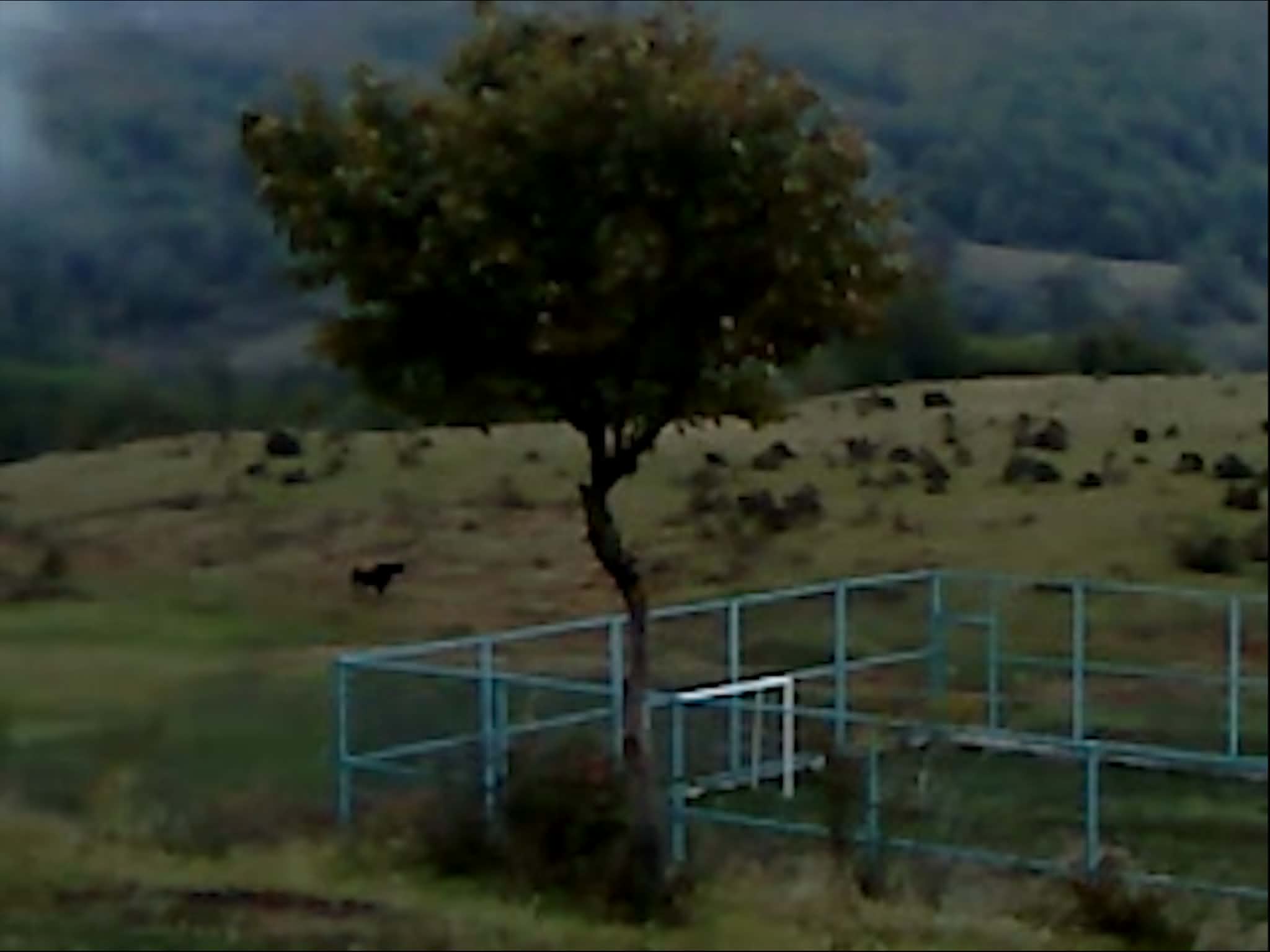
Alexandre Koberidze’s latest film transforms the search for a missing daughter into an exploration of memory, landscape, and the possibilities of cinema itself. Moving between urban and rural Georgia, Dry Leaf intertwines the visible and the invisible, inviting viewers to reflect on disappearance, human connection, and the poetic power of the moving image.
“There were cliffs
and unreal forests. Bridges spanning emptiness
and that huge gray blind pool
hanging above its distant floor
like a stormy sky over a landscape.
And between still gentle fields
a pale strip of road unwound.
They came along this road.”
Rainer Maria Rilke, from Orpheus. Eurydice. Hermes[1]
Mystery and Politics of the Seen and the Unseen
The impulse toward movement, displacement, and travel is embedded in the cinematic medium. Since its birth, road movies have carried traces of adventure, cultural exploration, and countercultural elements, pragmatic aims, quests, mythic origins, odysseys, migration, and countless political ideas, alongside an endless series of cinematic explorations. Yet, the disappearance of someone and the search that follows remain among the central motifs of road cinema: the search for a loved one, for oneself, or for a way through existential challenges. The road opens up countless possibilities, aesthetically, dramaturgically, and formally: to tell a story, to explore time and space, to test the possibilities of cinema, and to draw the viewer into a new adventure.
In this case, the story concerns the disappearance of a young woman, Lisa, a sports photographer who had been photographing football fields across Georgia. Her father, Irakli, a lecturer, sets out on the road to search for her. However, the investigation into his daughter’s disappearance gradually turns into an entirely unexpected visual odyssey. As often happens in road movies, the road itself becomes no less important than the destination.
In 1958, French film critic and theorist André Bazin placed a question in the title of his book as a principle of inquiry, thought, and vision, one to which we can always return as an artistic, cultural, philosophical, and political question: “What Is Cinema?” Georgian filmmaker Alexandre Koberidze’s film Dry Leaf (ხმელი ფოთოლი, 2025) makes us think once again about what cinema can be and how a filmmaker can become a kind of explorer, in some way returning to the moment of cinema’s birth through their approach to and relationship with the medium. The film won the FIPRESCI Prize at the 23rd Golden Apricot Yerevan International Film Festival.
The director takes an old mobile phone, a low-resolution Sony Ericsson,[2] and turns it into his instrument; it becomes a way of visual thinking and observing the world around us. Words like “dreamlike” and “poetic” may come to mind while watching landscapes, fields, and a world almost born in front of us. Koberidze himself is the cinematographer and the editor of the film, so he fully owns the visual logic of the film, with a relationship to light, editing, and almost a painter’s approach to making sketches of his surroundings.
The central role of Irakli is played by his father, David Koberidze, a non-professional actor. The music, which plays a crucial role in shaping the film’s entire texture, atmosphere, rhythm, and even the way its story unfolds, is composed by his brother, Giorgi Koberidze. It is precisely the music, entering the film from its very first seconds, that also returns us, in its mood, to the tradition of silent cinema: playful, imaginative, and sensitive. Throughout the film, it becomes one of its principal guides, almost a kind of signpost. This minimalist, family-based creative team, together with the modest instrument used for filming, determines the logic through which the world we see on screen is created. It is intimate, observant, careful, and guided by an acute sensitivity, curiosity, patience, depth, and a profound affection for the surrounding things, objects, places, living beings, and people encountered along the way.
In Koberidze’s films, one can always find a trace of a tale, as in his previous film, What Do We See When We Look at the Sky? (რას ვხედავთ, როდესაც ცას ვუყურებთ?, 2021). In this film, the characters lose their identities but continue living ordinary lives while searching for one another; their love for each other and cinephilia help them break the curse. Place also has a strong presence in the film: the city, Kutaisi, is explored with all its urban landscapes, streets, bridges, houses, and dogs; magical and real aspects also coexist here. The director plays with the audience as well, introducing rules to them, asking them to close their eyes, or telling them what they are going to witness.
In Dry Leaf, Koberidze once again creates his own playful elements and rules, this time by creating invisible characters. The only person who is willing to go on this journey with the main hero is an invisible companion, Levani, his daughter’s friend. Companionship in road movies is very important: with whom you share the road, adventure, hardships, and loneliness. We hear Levani but never see him; we know his movements and his thoughts but not what he looks like. This element introduces unexpected humour and something of the spirit of early cinema, repeatedly dissolving the boundary between the real and the imaginative.
This logic works in every layer of the film, including with characters and with places. They are approached in an almost documentary manner, but they also carry some sort of mystery within them. Additionally, Levani is not the only imaginary character. Among the people they encounter on the road, to whom the father shows a photograph of his missing daughter, Lisa, some are visible while others remain unseen. Each time, it opens up a space of surprise and gentle play. As Russian literary critic and philosopher Mikhail Bakhtin suggests, the road is a privileged space of chance encounters, where people normally separated by social and spatial distance may suddenly meet and their paths intersect.[3] In Dry Leaf, it becomes a territory of human connection, solidarity, help, mutual care, and love. It is where listening to one another, trying to understand another person’s story, offering a helping hand, and exchanging stories become forms of connection along the road.
The viewer also has the chance to meet a lot of interesting characters, such as children who can tell us about their lives, the difficulties their families experience, and what their everyday lives look like. Again, the love of football is a leitmotif here as well. The father searching for his missing daughter has only one clue: the football fields across Georgia that she had been searching for and photographing. Slowly, we understand that they are disappearing as well. Football always plays an important part in Koberidze’s work, especially children and football; in his previous film and here as well, the main characters’ lives are professionally connected to football. Children playing football become almost a manifestation of joy, life, unity, and solidarity. In rural places in Georgia, children always have a ball with them, and they can create their imaginary world around it; the author also does so himself.
The politics of the gaze is also important, emerging in the tension between the real and the unreal, the seen and the unseen, and in the way ordinary objects and people are captured with care and curiosity. This is the logic of the film, which becomes its rule: many things remain unseen but are still present, including images, characters, and the world surrounding them. Some things must be imagined and perhaps remembered by the viewer; using one’s own imagination also becomes part of the experience. What we can see and what remains unseen is both an aesthetic and a political choice made by the author.
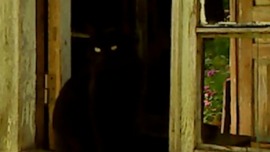
In Dry Leaf, this choice speaks through the film’s form, where the real and the imaginary constantly coexist. Through the camera, what is barely visible begins to emerge, even within sometimes blurred images and the persistent tension between light, shadow, and the possibility of encroaching darkness. Yet, this principle extends beyond the film’s form, its imaginary characters, and the absent daughter to the world that the camera encounters along the way (Image 1). Animals, dogs, cats, houses, old buildings, dishes filled with fruit, leaves, and passing fragments of everyday life are observed with particular sensitivity. The film draws attention to things that may remain unnoticed, restoring significance to objects, spaces, and moments that might otherwise disappear from view. This impulse recalls one of cinema’s earliest promises: to make the ordinary world visible and to seize and preserve people, objects, and fleeting moments before they vanish. This becomes especially important in a film whose movement and rhythm are shaped by the road, the surrounding landscape, the memory of places, and the changing states of human connection.
A Visual and Acoustic Journey Through Georgia
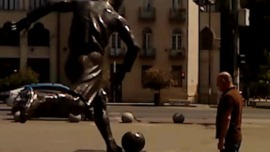
The journey begins in Tbilisi, the capital of Georgia, by moving through its streets, parks, university spaces, stadium surroundings, and riverside. The film gives even the city’s urban chaos a fairytale-like, poetic texture. Friends eat ice cream in front of Rustaveli Metro Station. Somewhere in Vere Park, a dog lives and needs care. The statue of Georgian footballer Boris Paichadze appears among the city’s other details, while interior scenes and small observations establish the film’s rhythm and atmosphere from the beginning (Image 2). This movement gradually acquires a wider scale as the journey leaves the city and continues through different regions of the country, capturing its rural landscapes in an almost mythopoetic way: hills covered in mist, open fields accompanied by music, and pauses inside hotels, private houses, and other interiors. Different locations seem to carry their own myths, while the camera and sound allow us to travel through the country, revealing both its mysterious beauty and its difficulties: visible hardship, damaged crops, economic realities, and, again and again, vanished stadiums, disappearing places, and people facing different challenges.
Through this visual and acoustic journey, accompanied by Giorgi Koberidze’s score, the viewer also discovers Georgia, its urban and rural landscapes, its difficulties and richness, and the impulses of its life. Alexandre Koberidze also returns to an essayistic form of storytelling that constantly appears in his films: the narrator’s voice accompanies the images as a storyteller. It does not tell much but instead gives us small glimpses or reflections on the story, the world captured, and the poetics of the road.
At some point, Lisa, who has until then remained absent, emerges as a voice through a letter written to her father. Her presence in the film, conveyed only acoustically, is also an interesting choice; she remains on the edge of the real and the imaginary. Her gentle voice and point of view in the story she tells do not give many details, but her emotional condition and the hardship of her choice appear in the film. She herself emerges as some sort of shadow, an almost ghostlike, mythical character returned to life. Her gaze accompanies her father’s gaze, which is also a very poetic aspect of this journey and of the film’s politics of the gaze more broadly.
Letters are Lisa’s way of communication, a form that seems to belong to another time. Before disappearing, she leaves a letter for her family; later, in an attempt to reconnect, she entrusts another to an unknown woman to pass on to her father. We never see this meeting itself: there are only clues and instructions for finding the place, turning it into a kind of riddle and leaving open whether it belongs to reality or imagination. This once again brings the film into the territory of the fairytale.
The observation and exploration of place, suspended between the real and the imagined, is also an important aspect of Koberidze’s cinema. Lisa asks herself, “Perhaps we even saw the same thing; is that not also a form of being together?” The love between father and daughter becomes a bridge across time and between places on the road. They are witnessing the same things, capturing the same world, objects, stadiums, and people. This shared gaze and love become some sort of resistance against all forms of disappearance in the film. Lisa also admits that it was when the demolition of the Sports University began that she first thought of leaving. Father and daughter watched together as a place dear to them disappeared. Later, we see the ruined building: once again, disappearance and erasure, this time of a physical space together with the memories it carried. The camera, however, preserves both the ruins and her verbal testimony to the building’s existence.
The loss of a person, the loss of places and shared memories, the invisible bond between father and daughter, the return to the same roads, the rediscovery of forgotten things, and the careful recording of everyday life all become part of the film’s attempt to resist disappearance. It may be a vanished football field, where children stubbornly continue to play even without the field itself, turning the entire world around them into a space of play. It may be an imagined or real companion who still helps the main character fight loneliness and despair. It may also be the ruined Sports University building, whose image becomes a form of protest against the destruction of important places.
In this sense, the film also creates a space for confronting loss and for grasping a fragile form of memory. The melancholy that accompanies the main character does not itself fade, but it instead seems to come alive through unexpected human connections, gestures of sensitivity, and the ability to recognise happiness in simple things. Once again, this goes to the roots of cinema, finding a manifestation of life and its poetry in the simplicity around us while creating the author’s personal visual dictionary of images and a principle of observing the world.
Koberidze’s film helps us to rediscover the magic of cinema through the barely visible traces of the world around us. This is again a political choice in a world of wars, economic hardship, waves of migration, and political dilemmas (which Koberidze also referred to in his acceptance speech when addressing the political situation in Georgia): an attempt to find poetry and the presence of human connection, love, and solidarity, and to encourage the search for ways of seeing, reimagining, and remembering. The festival slogan was also “Be a Poem”, which can be read in different ways but again raises the question of how something poetic can survive, resist, and remain present today.
At the moment of cinema’s birth, it was regarded as a technological wonder and a medium of discovery, and exploration, suspended between magic and reality as well as between mythmaking and the documentation of the world. Filmmakers believed that cinema itself was a kind of miracle: a field of unique possibilities in which one could invent a new language and create a new world. It could rewrite inherited myths and previously written stories from poetry and literature, shaping new ones through its own forms, meanings, modes of sensitivity, and visual vocabulary.
Koberidze continues this tradition. His cinema connects the visible and the invisible, the familiar and the unknown, and manifests both the unconditional love between a parent and a child and the bonds of solidarity that arise between strangers. Beyond the film’s experimental dimension, its emotional layers, humour, music, and shifting moods allow the pain of human loss to be gradually transformed through the discovery of the lost person’s traces, encounters with other people, and the rediscovery of the surrounding world. What we see connects us, and so do cinema and the road.
[1] Rainer Maria Rilke, The Unknown Rilke: Expanded Edition, trans. Franz Wright, Oberlin College Press, 1990, p. 41.
[2] Koberidze had already used the same technology in his first feature, Let the Summer Never Come Again (ნეტავ აღარასდროს მოვიდეს ზაფხული, 2017).
[3] Mikhail Bakhtin, “Forms of Time and of the Chronotope in the Novel,” in The Dialogic Imagination: Four Essays, ed. Michael Holquist, trans. Caryl Emerson and Michael Holquist, Austin: University of Texas Press, 1981, pp. 243–244.
Lika Glurjidze
Edited by Olivia Popp
© FIPRESCI 2026