
A Fire There: Between Home and Elsewhere
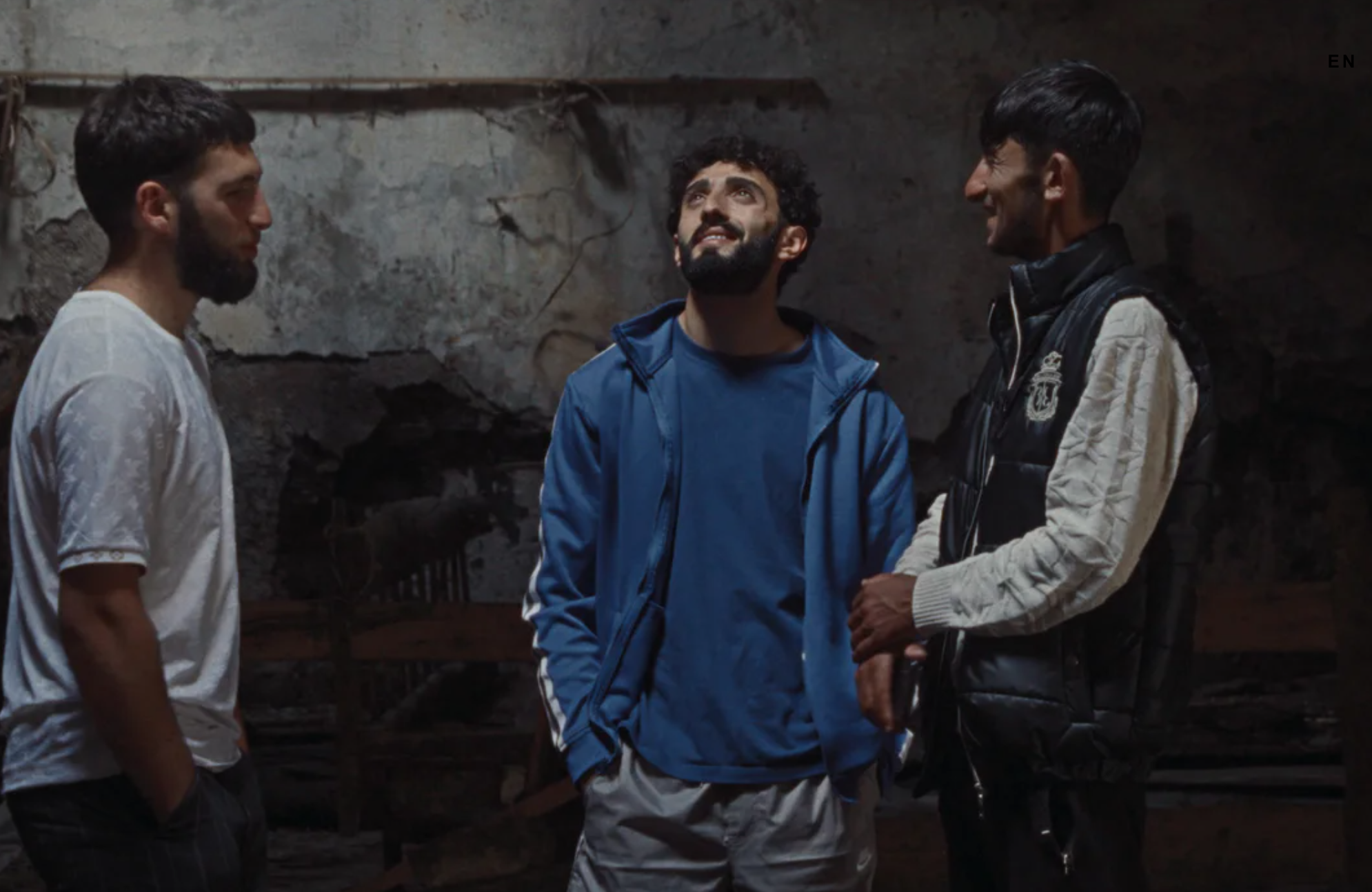
Marlene Edoyan’s documentary explores an Armenian community in southern Georgia through an intimate portrait of young men searching for belonging beyond simple notions of home.
For a filmmaker whose work consistently explores questions of identity and human geography, Marlene Edoyan’s A Fire There feels (Հեռավոր կրակ, 2026) like a natural continuation of her artistic interests. Based in Montreal, the Armenian–Canadian documentary filmmaker turns her attention to another Armenian experience beyond the borders of Armenia itself — not as an outsider looking in, but as someone drawn to the many ways Armenian identity continues to evolve across different geographies.
Her latest documentary, which screened at Flying Broom International Women’s Film Festival, takes us to Javakheti, a region in southern Georgia where a historic Armenian community has lived for generations. It is a place that quietly exists between cultural, linguistic, and political realities, where everyday life rarely fits into fixed definitions. Rather than turning this setting into a geopolitical statement, Edoyan approaches it as a lived landscape shaped by routine, memory, and the uncertainty of what comes next.
At the centre of the film are three young Armenian men navigating ordinary yet deeply consequential moments of adulthood. They tend livestock, help their families, fall in love, discuss politics, joke with one another, and quietly wonder where their futures lie. Some dream of leaving, while others remain emotionally rooted in the place they call home. Their conversations rarely produce definitive answers, but that openness becomes one of the documentary’s greatest strengths.
Women remain largely at the margins of the narrative. They appear as mothers caring for their sons, young girls performing traditional Armenian dances, or as figures of affection and emotional support. The camera, however, deliberately stays with the men — not to reinforce conventional ideas of masculinity, but to observe something that cinema rarely grants such patient attention: how young men hesitate, reveal vulnerability, imagine different futures, and negotiate adulthood without the pressure of performing strength.
Edoyan refuses to romanticise or dramatise her protagonists. They are neither heroes nor symbols of a disappearing tradition. They are simply young people trying to understand where they belong. Their awkwardness, sensitivity, and occasional silence become as revealing as conversations about work, family, or politics. The film allows them to exist in all their contradictions, resisting the temptation to reduce them to representatives of a generation or a community.
One particularly revealing thread follows a young man who leaves for Tbilisi and becomes involved in the city’s student protest movement before returning to his village. His experience quietly broadens the documentary’s perspective. Without turning the contrast between village and capital into a simplistic opposition, A Fire There reflects on a familiar experience shared across generations and cultures: leaving home inevitably changes the way one sees it. The city offers new political and social realities—yet, returning reveals that belonging is rarely resolved by geography alone.
What makes the documentary especially compelling is its observational patience. Edoyan comes remarkably close to her protagonists but never crosses the invisible line between intimacy and intrusion. The camera does not interrogate, manipulate, or seek dramatic confessions. Instead, it creates enough trust for everyday gestures, pauses, and conversations to become emotionally revealing on their own. This quiet empathy is perhaps the film’s greatest achievement.
The cinematography by Canadian cinematographer Étienne Roussy reinforces this approach beautifully. The images possess a restrained, almost understated poetic quality. The landscapes are never polished into picturesque postcards; instead, they retain their texture, imperfections, and changing light. Mountains, roads, family homes, and open fields become less a backdrop than an emotional geography, reflecting lives suspended between permanence and departure.
A Fire There is ultimately less interested in providing conclusions than in creating space for reflection. It never insists on where these young men should live, whether they should stay or leave, or what identity they ought to embrace. Instead, it recognises that uncertainty itself can become a defining condition of contemporary life.
By patiently observing the rhythms of an Armenian community in southern Georgia, Edoyan offers something that extends beyond questions of nationality or borders. She captures a deeply human experience of searching for one’s place while remaining connected to family, memory, and tradition. In doing so, A Fire There becomes not only a sensitive portrait of a particular community but also a quietly universal meditation on belonging, masculinity, and the many forms that home can take.
Diana Martirosyan
Edited by Olivia Popp
© FIPRESCI 2026