
Ji.hlava Interview: A Conversation with Trinh T. Minh-ha
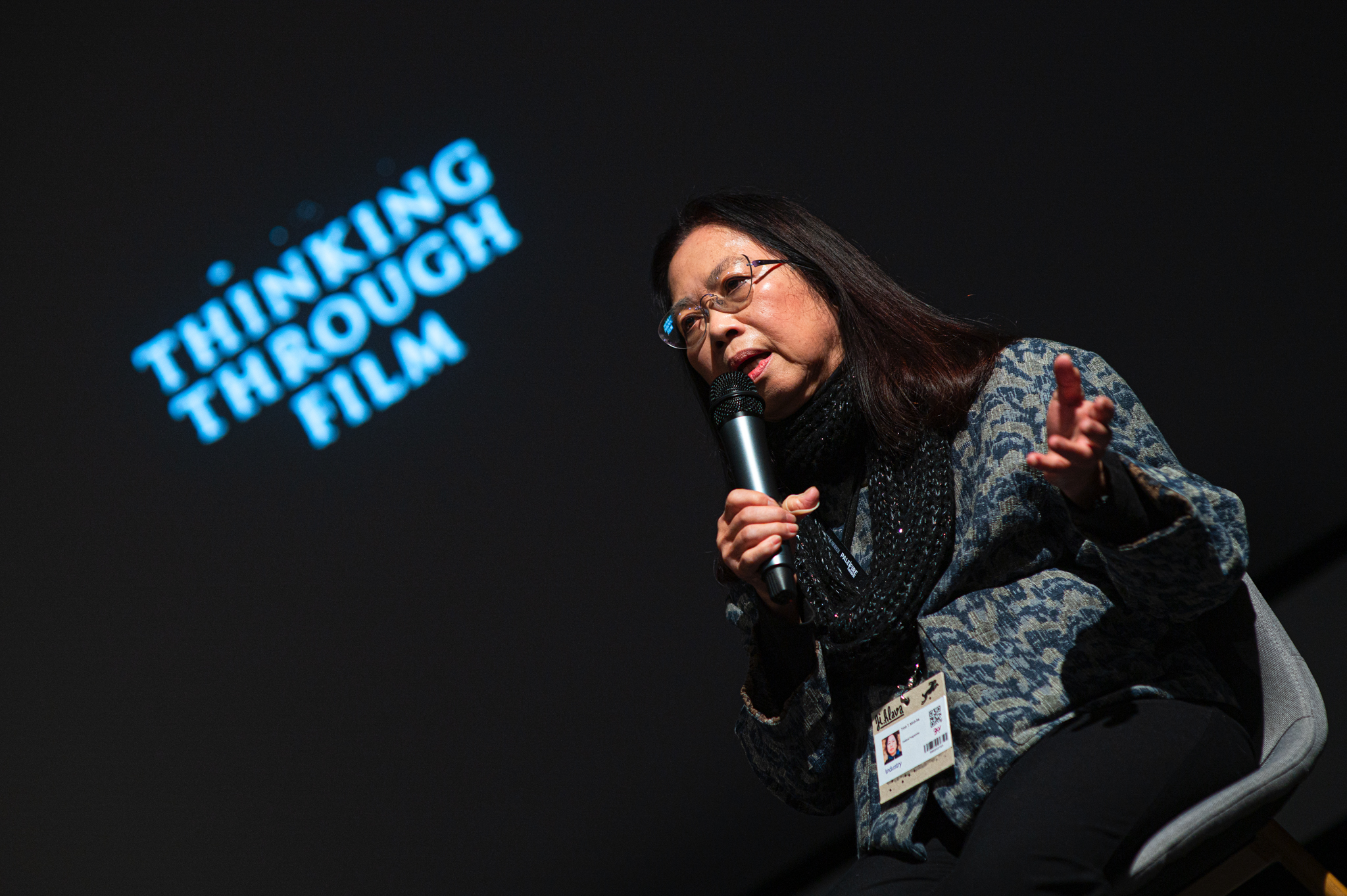
At the 30th Ji.hlava International Documentary Film Festival, Canadian critic Marc Glassman found time to interview the famed filmmaker-theorist Trinh T. Minh-ha, the recipient of a special award at the fest.
Jihlava, a small, picturesque city in Czechia, was lovely to experience with its cobblestoned streets and 19th century buildings creating a magnificent downtown core. The festival was run with charm, thoroughness, and dedication. There are a diverse group of cinemas dotting the city ranging in style from old fashioned movie theatres to roughhewn community centres, which serve Jihlava’s live theatre and music scene as well as films.
Other members of the jury will delve into more detail about the films we saw and our reasons for choosing Eli Maene’s Journey (Mobemo) as the winner. I was lucky enough to interview the esteemed filmmaker, theorist, writer, and academic Trinh T. Minh-ha, who won a lifetime prize for her “Contribution to World Cinema.”
Here is a condensed, edited version of my interview with Minh-ha, who broke through in world cinema with her first three films, Reassemblage (1982), Naked Spaces: Living is Round (1985), and Surname Viet Given Name Nam (1989). She has gone on to make such films as Shoot for the Contents (1991), Forgetting Vietnam (2016), and What About China (2022). Minh-ha is renowned as a writer, particularly for the book Woman, Native, Other: Writing Postcoloniality and Feminism (1989), which opened up literary theory over three decades ago. She is a professor of Gender and Women’s Studies and Rhetoric at University of California, Berkeley.
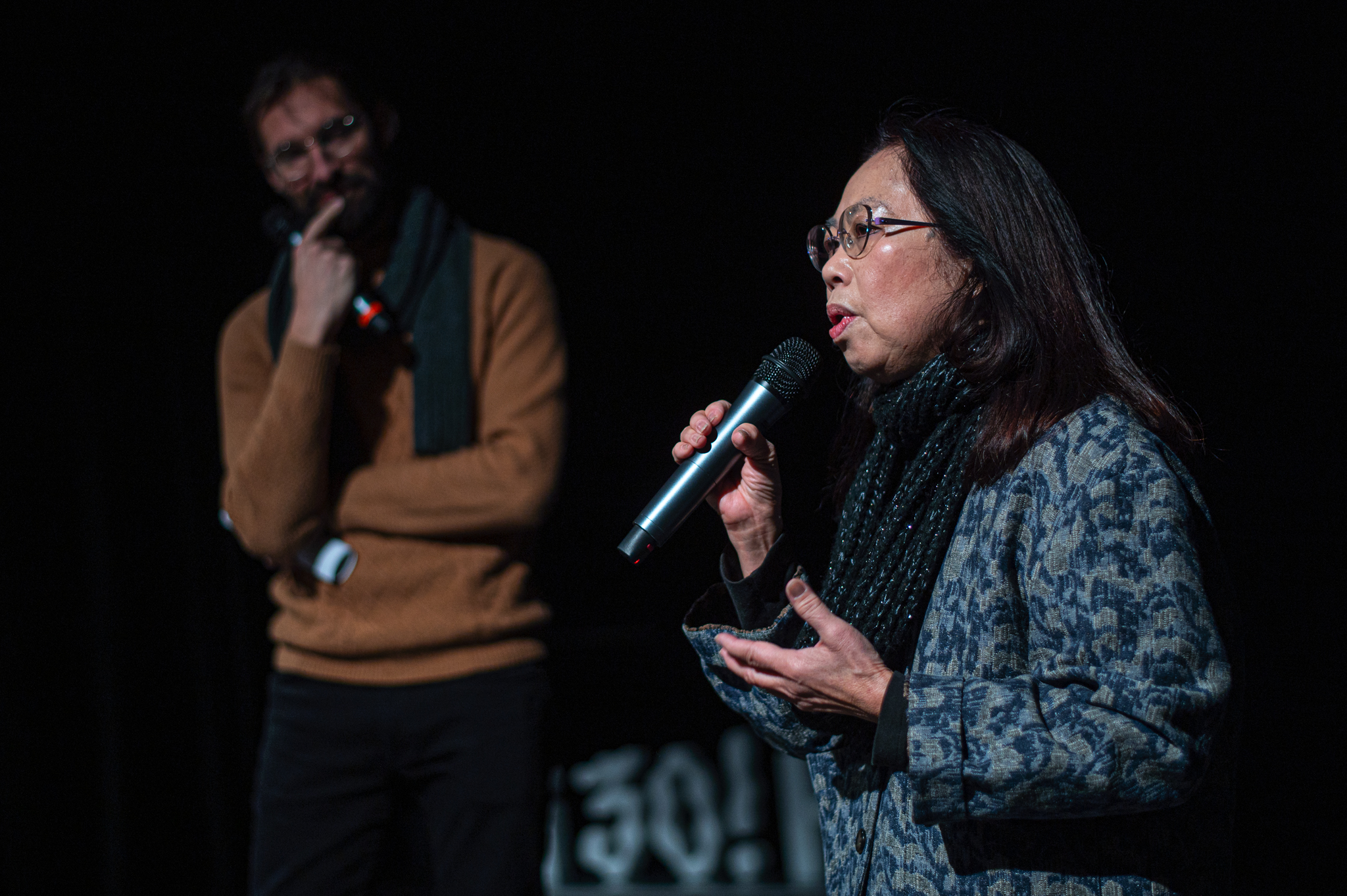
MG: Marc Glassman
TMH: Trinh T. Minh-ha
MG: What kind of reaction did you receive when Reassemblage was released?
TMH: I didn’t have a glorious time. On the contrary! I had just come back from Senegal when the film was shown at the Flaherty Film Seminar. It’s amazing that the film got picked up then. I had lots of hostility from the audience at the time. I remember after the film screened, a man who spoke with lots of authority stood up and said, “Your soundtrack is really a disaster.” So, I immediately asked him, “Why is it a disaster?” Then an elderly woman stood up and disagreed with him. That started the discussion. Some of the people really got angry and other people defended it.
It has been like that for me ever since for most of my films and my books as well.
MG: Is it better now?
TMH: It has been less lately since I’ve been traveling and showing these films and having retrospectives.
MG: Did people at Flaherty know that you had a music background? It’s obvious now that you were creating a more poetic way of constructing a soundtrack.
TMH: At Flaherty, people would just step all over you. If you didn’t have a loud mouth, people would immediately think that it was because you were weak and didn’t know what you were doing. The structure of the film used black frames visually and silence in the soundtrack. I included ambient sounds of birds chirping or water running or even room tone. For me, it all goes together. But of course, it takes a lot of time to share that with the audience.
MG: I think they didn’t understand that you were signaling that you were making a film, not a piece of anthropology.
TMH: I had studied ethnomusicology and read all kinds of anthropological writings. But the point for me is that my film was not anthropology. The whole thing is that you have many ways to approach cinema. Why do you have to have all these rules of what a good documentary is or what a good anthropological film is? One of the first things I said was “I don’t want to speak about people. I really want to speak nearby.” It’s very challenging because you are going for something that is at the same time very intimate, because you are next to the person, but you don’t claim to speak for them. You don’t occupy that space. Speaking nearby is active, whether I’m next to that person or whether the person is absent. It’s not simply objectifying and speaking about someone.
MG: Should documentary be objective or subjective?
TMH: For me, there is no absolute binary opposition. Even within the area of subjectivity, Chris Marker in Sans Soleil, has a very different subjectivity than mine. I would say that if we were to sketch something that is round, which we call subjectivity, he would be a dot since he’s humbler than someone who claimed the whole knowledge, but I’m not even a dot in that circle. I’m the many threads that come together.
You gain a lot by losing self-expression, which is something that artists claim very strongly, right? For me, in order for the self to have room, you have to void yourself. Then you are very vibrantly who you are, but at the same time you leave yourself open to all kind of things that you encounter. Life comes to you, rather than simply always projecting yourself.
MG: When you made your next film, Naked Spaces: Living is Round, you talk about the construction of a village as being matrilineal and circular. Is this something that you learned from being in Africa?
TMH: Very much so. I would say that the question of the circle is really across Indigenous culture. In Naked Spaces, Living is Round, the structure of the film begins and ends with a dance of initiation. All the elements of cinema—music, sound, light, image, commentary—work out in such a way that it comes back as a round.
MG: For Surname Viet, Given Name Nam, you create a hybrid work, which plays with what is true. Was it interesting for you to play with identity in the film?
TMH: There’s an element of surprise in the film, but I discovered that anyone with an eye for the cinematic can see it right away. There are, first, interviews that were done with women which are shared with the audience. Then the camera is set up to follow the women as they do their daily activities and they talk again. That is more what the documentary world is familiar with. So, there’s a part that is like fiction because it is all set up and then you have the second part that is more like a documentary. But they are both ways of approaching truth.
MG: Have anthropological films and some standard documentaries become less dogmatic?
TMH: Let’s approach the notion of reflexivity, how you expose yourself. There’s a way that anthropologists have always done: they tell you how long they stayed in a place and how they worked in their process, but for me that’s not enough. Reflexivity—speaking nearby and all of these notions that we come up with—have to work on all dimensions of the film. It means having a camera that speaks nearby. If a young filmmaker is using different elements of cinema sensitively, then I think it’s wonderful, but I think it’s very rare.
MG: You’ve taught for many years. Are you happy with what your students have done?
TMH: I left the film department because people couldn’t deal with someone who published in music and literature. They called me an unknown academic entity. Now, I have music students and people from education and anthropology.
MG: How has anthropology and filmmaking practice changed for you over the years?
TMH: Anthropologists today talk about reflexivity very easily. But how do you use it? It’s reflexivity not only toward yourself and the viewer, but being reflexive between one image and another, between one sound and another, one commentary and another.
I work with a cluster of concepts; for example, the concept of resonance, which is musical but also resonant in many ways. How do you put together a long film without any story? You have to have rhythm, resonance, and many sensorial elements in order to put together a large amount of material without needing a story, without spending time trying to explain meaning.
MG: How would you characterize your films?
TMH: A curator at the Tate Modern called my work “anti-essay films.” I’m very happy with that because I don’t claim a category. I work between categories. The space between is so much richer because you have freedom to move between fiction and documentary, between being cultural or educational. My works can be many things at the same time. If you fit my films in the essay category, which seems closest to what I’m doing, it’s not only about ideas. You are taking off 70% of the film if you call it an essay.
MG: Are any of your films autobiographical?
TMH: It is autobiography in the sense that the more you go inside, the wider you are open to the world. Then you can begin to understand the situation of someone who is so far away from you. It’s not about my life, but it certainly is very intimately my reality.
MG: How do you assess your career?
TMH: How many tickets did I sell or how many millions did my films make? (She smiles) I define my audience as being very large, and not because of numbers, but because it cut across many cultures. I keep on receiving feedback from people who live far away: women from Vietnam, from Bologna, from Palestine.
When you choose any kind of subject, you always have that scope in mind. You hope that many people can come in and identify with whatever you choose to offer. People who say “I” in poetry are not writing about one single individual. They are inviting everyone else to own that “I.” I’m very grateful because I have that large audience.
Marc Glassman
© FIPRESCI 2026