
Auber 89: a personal and political use of archive at Dok Leipzig 2026
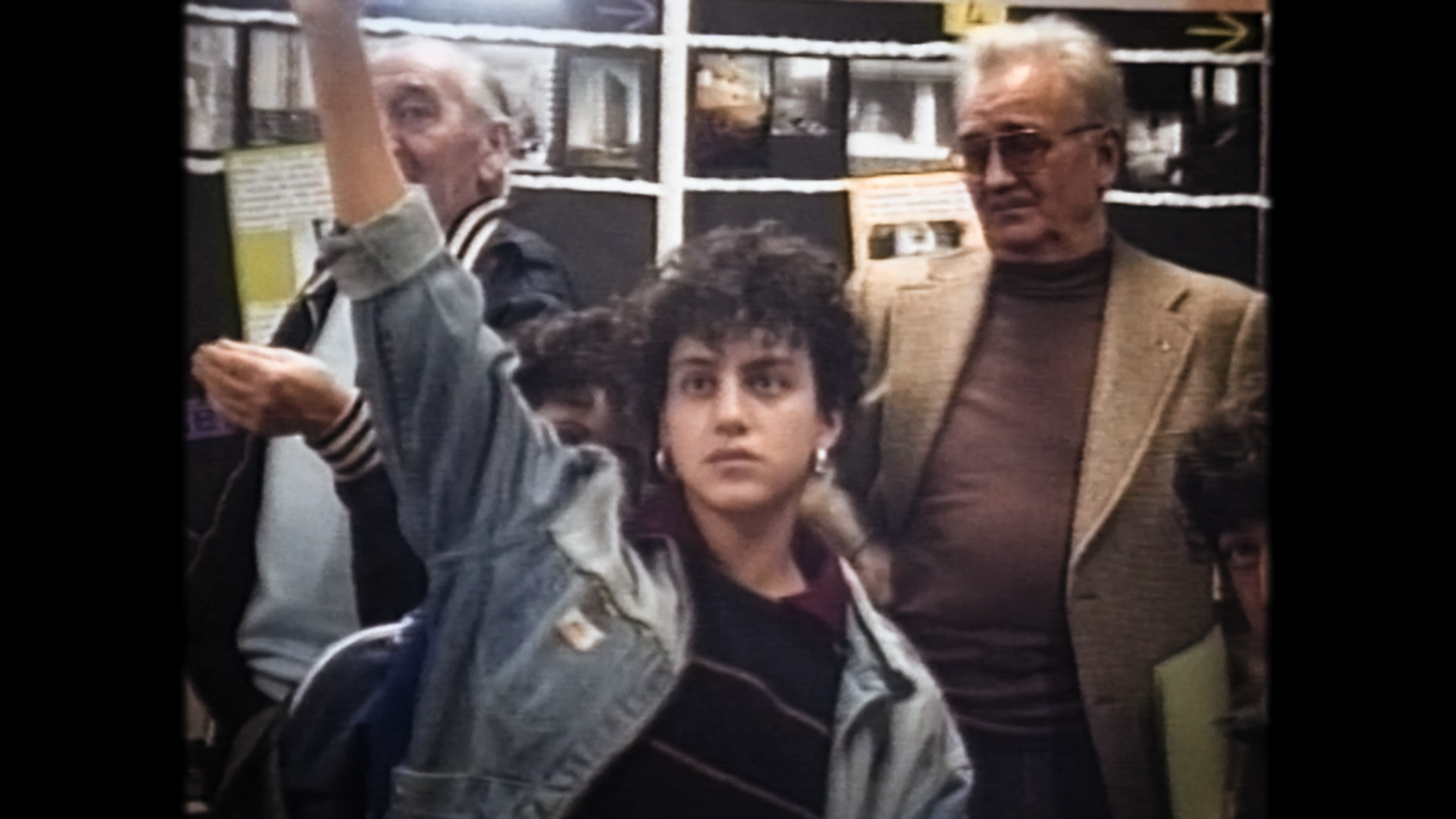
The documentary of Giuseppe Schillaci touches on social and personal issues through hours of footage found in the town hall of Aubervilliers.
“My heart stopped but I’m not dead”.
It’s with the recollection of an incident and the subsequent amnesia that Auber 89 starts its oceanic flux of images and memories. The director Giuseppe Schillaci (born in Palermo) opens in front of our eyes a treasure trove he found in the archive of the town hall of Aubervilliers: hundreds of hours of footage from the 80’s that depicts daily life in the French suburb, just outside Paris. By chance —or maybe it was destiny—Schillaci was able to meet Fatsah Bouyahmed, today an actor. Fatsah, as a child, is present in those archival images.
Auber 89 finds its life in this tension: a grown man (who suffered the loss of his memory) confronted with images of his youth. Fatsah can see once again the Aubervilliers where he was born, as well as all the hopes and contradictions that the 1980s carried with them for the French banlieues.
In fact during that time the president François Mitterrand had just launched the “Banlieus 89” project, a national program that intended to rehabilitate the suburbs. In the archive’s images we see a recurring theme all the time: families and people from social housing are confronted by architects and government officials, they get asked for their opinions about how to reshape the neighborhood. In those images every face tells a story, there was hope in those moments.
Fatsah remembers the turmoil in that moment of transition: the fascist parties in France started to complain that the government was spending money for the Algerians (as Fatsah himself) from the banlieues, even in the social housing clashes started between the young and the elderly people. In this way Auber 89 adds another layer of meaning: the documentary is no longer just a social commentary and Fatsah’s personal recollection, but also allows for the dissatisfaction of youth to enter Schillaci’s discourse. One of the emotional climaxes of the movie regards a girl that keeps raising her hand during a meeting but no one lets her speak so she puts her hand down and we can clearly see the anger growing on her face: an image which already encompasses everything without the need for words.
Then there is the theme of the need to confront ourselves with our past. Fatsah remembers that in his youth he thought “I am Auber, I love Auber but I can’t live in Auber.” He decided to go away and started to pursue his career in theatre. At one point, Fatsah had an incident that caused severe amnesia. It’s at this moment that the archive rediscovered by Schillaci opens up cinema’s mystical dimension. Those images, so ancient and buried in Fatsah’s unconscious, can reactivate a memory. In front of Schillaci’s camera, Fatsah starts to think about those images, to question his life and his past that was lived “with a lot of warmth but not with a lot of money,” in his own words.
In Auber 89 personal and social dimensions connect with each other all the time. At the end, Auber 89 touches on a sad matter of fact: the “Banlieu 89” project was halted due to a lack of funding by the French government, all those promises were lost and nothing was done, the suburbs had to stay in the unknown and in the hands of the fear and the rage of the people who lived in them.
With this observation the subversive energy of Schillaci’s documentary emerges with all its force: Auber 89 feels almost like a genealogy of the social anger that still today lives inside the French suburbs, where people feel betrayed by the politics (but this way of thinking extends way beyond France). The final images are dedicated to the demolition of a social housing estate in 1995 with a sad voice-over from Schillaci: “We build, we destroy but for how long can we continue on this path?”
Schillaci, almost like a demiurge, creates links and connections, he reflects on the similarities between the Palermo from his youth and Aubervilliers (a context just apparently different). Mostly, Schillaci gives us, through Fatsah, an honest and enamored gaze that looks back with love on that time, the last age of innocence before the hands of capitalism finally took over the communal life of families and society completely. Auber 89 proposes a sweet and melancholic use of the archive, one that mixes personal and social dimension to remind us that some images will stay with us forever, even after an amnesia, even after the demolition of the building where we spent our childhoods.
Marco D`Agostino
Edited by Savina Petkova
©FIPRESCI 2026