
Interview with Giuseppe Schillaci, director of the documentary film Auber 89
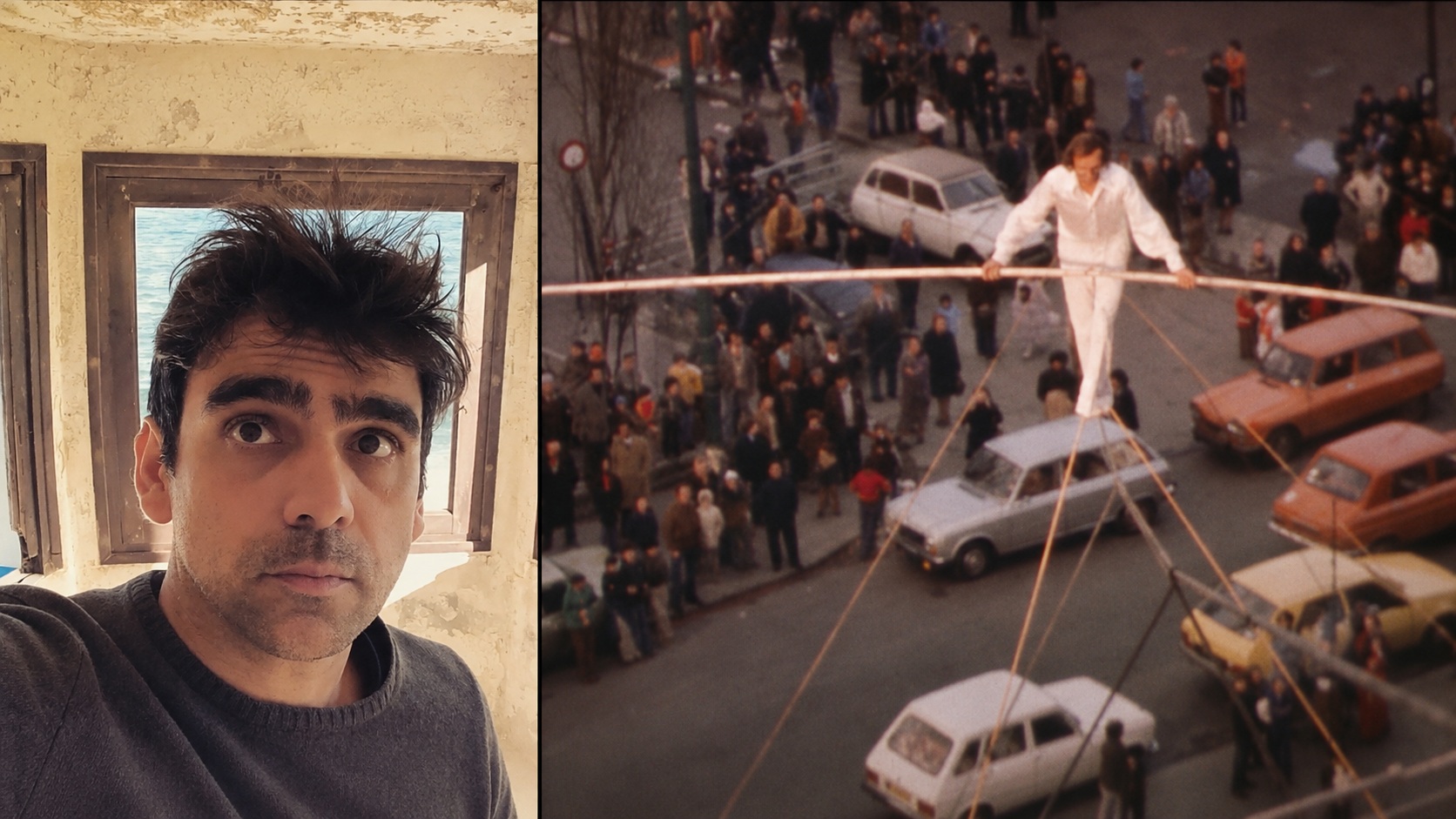
Igor Angjelkov speaks with Giuseppe Schillaci about the footage that became Auber 89. Their conversation follows the material from a municipal archive to a film about memory, housing, and whose voices are heard.
The strong selection of creative documentary films at the 69th edition of the Leipzig Festival brought forward diverse authorial voices and approaches to themes that are highly relevant to the times we live in. For the members of the FIPRESCI jury, one film stood out in particular, in “achieving an extraordinary feat—being simultaneously intellectually complex and widely accessible. It tells deeply human stories while addressing political issues that are exceptionally relevant today. Through archival research, the film reconstructs the contradictions of capitalist modernity: progress and decay, migration and isolation, exploitation and emancipation… all narrated through the eyes of an eloquent and empathetic protagonist.”
Igor Angjelkov: Mr. Schillaci, how thrilled were you to receive the FIPRESCI Award in Leipzig, especially considering it comes from the oldest association of film critics in the world?
Giuseppe Schillaci: It’s a real honour for me. The FIPRESCI Award is a very prestigious one, especially for an independent film such as ours, which we made with a lot of passion and less money than we needed. It’s also funny, because just before it we received the Young Jury award at Archivio Aperto in Bologna. Different generations are appreciating our film, and in a way that was the artistic and political aim of my work.
Auber 89 had its world premiere at the world’s oldest film festival, the Venice Mostra, within the Giornate degli Autori – Notti Veneziane 2026 program. What kind of experiences and reactions from your peers did you bring back from there?
It was very emotional to be back in Venice. Bosco Grande (2024) premiered there two years ago, so it felt like a confirmation. And I was happy to share it with the editor Christine Bouteiller, Antonio Carola, who did the post-production and the colour grading, the producer Raffaele Ventura, and two key figures of the film, the architect Patrice Lutier and the community organiser Carlos Semedo. They watched the film for the first time there, which made the evening even more special.
This was followed by your first festival accolade, the Audience Award for Best Documentary and Special Mention at the Ortigia Film Festival 2026. In Leipzig, you joked at your own expense that, so far, none of the awards have come with prize money…
It was a joke, but a serious one! I’m very happy that important institutions like yours, or OFF in Italy, recognise the film. But filmmaking is also my livelihood, and in creative documentary directors are precarious and badly paid. So a prize that comes with some money is very welcome.
Alright, we have covered the festivals and the awards… let’s dive into what Auber 89 is really about. To start with, many are probably wondering how you got the opportunity to discover all those archival recordings of the Paris suburb of Aubervilliers. For a filmmaker, that is an absolute treasure trove!
It wasn’t a plan, it was an accident of an artist’s residency. I’d gone to Aubervilliers to make a film about the present: the housing estates in the Monfort area were being demolished, families rehoused, the area gentrified… I saw some photographs from the 1980s, and then I discovered they were just the tip of an enormous mass of video footage. Those faces, that grain, those eight- and ten-storey blocks… They looked like the housing estates of my childhood in Palermo. I thought: “This looks like my home!” From that moment on, I wanted to dive into the material.
Part of those videos had been digitized in the 2000s by a researcher from Aubervilliers. The footage was shot in the 1980s by the municipality, its staff and the architects working on urban regeneration. I started pulling threads, and cassettes and dossiers came out, along with rushes that had never been digitized, which we recovered ourselves. I tracked down the people who actually made the images: the architect Patrice Lutier—who shot a lot of it himself—and Denis Ralite, who handled sound. Thanks to them we found not just the films edited at the time, but the original rushes on Betacam and U-Matic. In the end it was over a hundred hours [footage]. I felt like an archaeologist, which is what I wanted to be as a child: you remove one layer of sand, then another, and the story was already there, waiting to be told.
You are an Italian director living in France. At the beginning of your film, you mention that all those recordings reminded you of your childhood in Sicily. Could you give us a brief personal profile—what is your hometown, where did you grow up, and how did you eventually end up in France?
I grew up in a working-class neighborhood of Palermo, between Settecannoli and Brancaccio. In the 1980s the city was in the middle of the Second Mafia War, and I really felt that violence and criminal oppression was in the air. I wanted to emancipate myself from that environment, so once I was at university in Palermo, I knew I had to leave. I chose Bologna, which is well known for its humanities and cinema faculties.
After Bologna I moved to Rome, because in Italy, if you want to make films, you have to go to Rome. But I soon realized there was no room for me in that scene. So I started working with French producers to finance my films, and in 2013 I moved to France. I’m very happy with that choice. My daughter was born here, and Auber 89 is my first film set in France.
And, of course, we must not forget the pivotal question: when did you fall in love with the art of cinema? I imagine that with a cinematic heritage featuring names like Antonioni, Fellini, Pasolini… it isn’t all that difficult to want to become a filmmaker in Italy.
I don’t think there was a single moment [I can point out]. I come from literature and music, and I published two novels before making films, so cinema felt less like a calling than a natural evolution of the same research: how to give form to memory, to places, to the people who inhabit them and to some “sacred” feeling of mystery in human lives.
Of course, Italy has an extraordinary tradition, and Fellini/Pasolini/Petri are an enormous presence for me. They taught us the importance of filming faces and places that are at the heart of Auber 89. But the tradition is also a heavy one. The Italian system of public funding has been very limited in recent years and the industry is quite closed, so I wasn’t able to make films like this in Italy. I hope it will change in the future. But perhaps that was a blessing in disguise. Living and working in France opened my eyes, and in a world this complex, we always need to look in different directions.
Returning to Auber 89, I believe you demonstrate in the best possible way how accidentally discovered archival footage can be turned into a socially and politically engaged documentary. In these perilous times we live in, to what extent do you feel that film—and the documentary genre in particular—needs to be engaged?
I think film needs to be engaged, but not in the sense of delivering slogans or a ready-made message. Auber 89 is, in fact, a very political film, but it works through people and feelings rather than abstract theses. The politics only came alive when it passed through a person, through Fatsah’s intimate memory, his friends, his cousin, his bitterness and his nostalgia.
What the archive shows is that nothing explodes out of nowhere. Going back to the 1980s helps us understand where today’s separations come from. We have also been shaped by the clichés of the banlieue film, like La Haine (1995), which I adored as a boy. I had those prejudices myself, and the archives showed me another France, one of working-class towns that only later became ghettos.
Today public money for community work is shrinking, and politics tends to build labels and walls, an “us against them.” For me, documentary can offer a different gaze: it can remind us that people can live together with their differences, and that this is something we need to start from again. That is where I think engagement lies: in looking closely, giving trust to the people we film, and giving space to those who are never given it.
The material which you say reminded you of your childhood felt to me, too, like a true immersion into the collective matrix of the past. In Macedonia as well, as part of the former Yugoslavia, stories similar to the ones you portray in your film were unfolding. By taking us back to a time when people still communicated with one another for the good of the community, your film actually speaks volumes more about the present—a present in which we frequently ask ourselves: “Where did we go wrong in the past, and what should we have done differently so that we could live better today?”
Thank you, that parallel moves me, and I think it confirms something I felt while working on the film: we are much more similar than we think. I discovered those images far from home and yet they felt like mine, because the faces, the grain and the blocks of flats belonged to a shared 1980s. Instead of always looking at differences, we should look at affinities. The same can be true across Europe, from the Parisian banlieue to Palermo to Macedonia, etc. we can recognize that spirit.
The 1980s still carried the long tail of the ideals of the 1960s and 1970s. People were working on togetherness, on community, on what it meant to share a space. Then 1989 arrived, with the fall of the Wall and the advance of History, and that magnificent illusion was broken. What followed, from the 1990s onwards, was a long season of hatred campaigns and of politics built on labels and walls.
I don’t think the film offers a definitive answer to “where did we go wrong?” It doesn’t claim a final truth. But the archives suggest a few things. Participation was sincerely promoted, yet the people it was meant for, especially young people, women and the children of immigrants, were often invited without really being given the floor. Frustration grew into anger, and anger into hatred. Fatsah put it simply: “we were alone, our fathers weren’t there.”
So perhaps what we should have done differently is to listen, truly give people a voice, and keep investing in the spaces where different people can live together. That may be where we need to start again from.
To break up the archival footage, the choice of French-Algerian actor Fatsah Bouyahmed works incredibly well, as he tries to recover his memory after an accident using 1980s archival footage from his childhood home in Aubervilliers. It seems it wasn’t easy to reach him, let alone convince him to be part of the film, especially since he emphasizes that once you leave the suburbs, you almost never want to go back.
It was a gamble, because I didn’t even know him. While I was showing the footage to residents to work out who the young people in it were, someone recognized Fatsah and told me he was now a well-known actor. I didn’t know he was a Franco-Algerian actor at all. I got his number and called him.
He said no. He told me, in a fragile voice, that he’d just had an accident, that he’d lost his memory, and then once you’ve left the suburbs you don’t want to go back. He didn’t even want to see what I’d found of his childhood. I told him, “I have your memory here,” but it didn’t work. It was a difficult start.
I respected his decision and kept editing, even imagining a fictional character inspired by him, as I’d done in The Modernissimo of Bologne (Il Modernissimo di Bologna, 2022)But after a while I felt like an impostor. He was a real man, alive, and I didn’t feel entitled to take over his story. So I called him again and tried to be as convincing as I could. He first suggested Zoom, then maybe over Christmas, and in the end he told me, “Prepare the camera and do what you have to do.” A month later he came to Paris.
The method was simple: I said, “Look at the images, stop whenever you want, and tell us.” I also opened up about my own memories of Palermo and the similarities. That created a real chemistry between us. He started laughing, crying, telling stories, recognizing people and rebuilding the atmosphere of the neighborhood. In those five hours, in a single interview, the whole film was there: the utopia of change and the world that was crumbling. And at the end of the film he says, “I am Aubervilliers.”
I, however, believe the opposite: that living in the suburbs of a metropolis, especially during childhood and one’s formative years, is vital for a person—particularly if they later choose to practice any form of art. The experiences and memories from the suburbs are the very nourishment that can sustain your entire artistic engagement for the rest of your existence in this world, which is a beautiful thing. How important are an individual’s memories to your work?
I agree, and I’d add something. I wanted to emancipate myself from the neighborhood where I grew up, and I left. But I’ve never really left it. It’s a visceral bond. I lived in Palermo until I was twenty, I’ve gone back many times, I’ve shot three films there, and the two novels I’ve written, and the one I’m writing now, all deal with my origins. Those childhood and adolescence years are the nourishment of everything I do.
In my films and my books there is quite always the same starting point: a place, or a character who can capture its soul. I’m fascinated by memories tied to places. Some spaces become real deposits of experience, a stratified genius loci. To bring out what they contain you have to dig, and cinema, like literature, can help us do it.
That is exactly what happened with Auber 89. I was in a neighborhood which wasn’t mine, and after only a few images I thought, “This really looks like my home.” The eight- and ten-storey blocks, the football in the street, the faces, the grain of the video belonged to the memory of my generation. It was like a childhood that wasn’t mine, but felt as if it were. It even allowed me to imagine a parallel French childhood.
But I’m wary of memory as pure truth. Memory tries to make sense of images, even when that sense wasn’t there originally. We complete what we see with what we remember, what we’ve forgotten, and even what we would have liked to live. There is always room for invention. That is why I think identities are like Russian dolls, layers that overlap and can’t be forgotten. Palermo remains, but France has shaped me too. Purity is a myth that creates monsters. Memory, personal and collective, is the thread that ties all my work together.
These days, Europe is flaring up once again. We are witnessing fierce protests in France, Italy, Germany, Portugal, Albania… while at the same time, students in Serbia have shown how to topple an authoritarian regime with new, fresh faces and ideas. How do you view the current situation on the Old Continent? Is there hope for us? And yes, where did we go wrong in the past for this to be happening to us today?
I’m a filmmaker, not a political analyst, so I’ll answer from what my film taught me. I’m glad you mention young people, because they are the heart of this story. In the Aubervilliers archives, the young people and the children of immigrants were invited to participate, yet they were rarely given real space to speak. When a generation finally takes the floor, as the students in Serbia have, it is a sign that something is moving. It’s inspiring for us and all the European youth.
As for where we went wrong, I can only point to what I saw in the images. In the 1980s there was still the long tail of the ideals of the 1960s and 1970s, a work on togetherness and community. Around 1989 something broke, and from the 1990s on came a long season of hatred campaigns and politics built on labels and walls, an “us against them.” Public money for bringing people together keeps shrinking, and what survives is increasingly voluntary and minoritarian. We went wrong when we stopped investing in the places and relationships where different people live together.
Is there hope? I’d say yes, but not an easy one. Looking back to the 1980s doesn’t mean nostalgia. That decade carried both the desire to be together and the seeds of conflict. But it reminds us that these separations have a history, and what has a history can change. Perhaps this is a moment to start again from there: living together, each with our differences.
How should the art of cinema respond to current events? Can documentary film shift perspectives and influence processes to improve people’s lives?
Cinema shouldn’t chase the news. Its strength is time: looking at memory, places and people to understand how we got here. For me that means looking closely, with trust, and giving space to those rarely given it. Can documentary change lives? I’d be careful to promise that; a film doesn’t change a law by itself. But it can shift a gaze, remind us that people with different histories can live together, and that walls and labels aren’t inevitable. That is where change begins, even more if the young generations are involved.
What are the future plans for Auber 89?
After its world premiere in Venice and its release in Italian cinemas with Revolver and Valtellina distribution, the film is now touring festivals thanks to Lightdox international sales. Its first screening in France will be on 8 November in Saint-Denis, a mythical suburb right next to Aubervilliers, at the Cinébanlieue Festival. In a way the film is going back home. I hope it will be seen by young audiences in France and elsewhere in Europe.
Are you already working on a new project?
Yes, several at once. The most advanced are a documentary about Petrolio, Pier Paolo Pasolini’s last, unfinished novel, and a film about Italy’s colonisation of Libya. I hope you’ll like them too.
Igor Angjelkov
Edited by Savina Petkova
©FIPRESCI 2026