
Childhood, Evil and Memory at the 59th Sitges Film Festival

Childhood, Evil and Memory at the 59th Sitges Film Festival
Each edition of the the Sitges – International Fantastic Film Festival of Catalonia, held this year from 8 to 18 October, is organised around a thematic thread. In 2026 the festival found two anniversaries that converge almost perfectly: fifty years since Carrie (1976) by American director Brian De Palma and Who Can Kill a Child? (¿Quién puede matar a un niño?, 1976) by Spanish director Narciso Ibáñez Serrador.
The first gave the festival its official poster and its focus on cursed adolescence, psychic powers and trauma. The second provided a closely related leitmotiv: evil associated with childhood. Around these two films the programme brought together restorations, new productions, documentaries, a book and an exhibition, inviting audiences to reconsider one of the most persistent and uncomfortable figures in fantastic cinema: the child who frightens.
The figure is, of course, older than both films. Fantastic cinema had already explored it in The Bad Seed (1956) by American director Mervyn LeRoy and Village of the Damned (1960) by British director Wolf Rilla, adapted from John Wyndham’s novel The Midwich Cuckoos. The Exorcist (1973) by American director William Friedkin turned a possessed girl into a mass phenomenon, and in the same year as Carrie and Serrador’s film, The Omen (1976) by American director Richard Donner introduced the child as Antichrist.
That coincidence suggests that 1976 was not an arbitrary choice: it was the moment when the evil child became a central genre archetype. Its power lies in a simple inversion. Modern Western culture has made childhood the territory of innocence and protection, and horror cinema has repeatedly exposed how fragile, and how ideological, that construction is.
Who Can Kill a Child? remains the most radical Spanish contribution to this tradition. Based on the novel El juego de los niños (The Children’s Game) by Spanish writer Juan José Plans, it follows an English couple, Tom and Evelyn, played by Lewis Fiander and Prunella Ransome, who travel to a small Mediterranean island and gradually discover that the children have killed almost all the adults.
Serrador opens the film with a long montage of documentary archive footage showing children as victims of twentieth-century wars and famines, a prologue that frames everything that follows. The violence of the island’s children appears less as innate evil than as a collective response to the abuses of the adult world.
The festival’s own presentation describes the film as an exploration of lost innocence through the children’s revenge, and that reading still holds. What remains most striking is its formal audacity. Cinematographer José Luis Alcaine shoots horror under a blinding summer sun, in whitewashed streets and empty squares, without the shadows on which the genre usually depends.
The score by Argentine composer Waldo de los Ríos, built on distorted children’s voices, adds a layer of unease that never needs to be emphatic. The film was partly shot in Sitges, which gives its return a particular local resonance.
Its weaknesses have also been noted over the years: some critics, Time Out among them, argued that a subplot concerning the pregnant protagonist dilutes the political charge of its premise. Seen again today, that thread seems to me more coherent, since it extends the threat to the unborn child and closes off any possibility of escape. The screening of the restored copy was accompanied by guests linked to the film, including Marián Salgado, one of its child performers, and Alejandro Ibáñez.
Carrie offers a different but complementary version of the same theme. Carrie White, played by Sissy Spacek, is not an evil child but a humiliated adolescent, bullied by her classmates and oppressed by the religious fanaticism of her mother, played by Piper Laurie. When her telekinetic powers explode on prom night, the film turns the victim into a monster, and the audience is forced to recognise who created that monster.
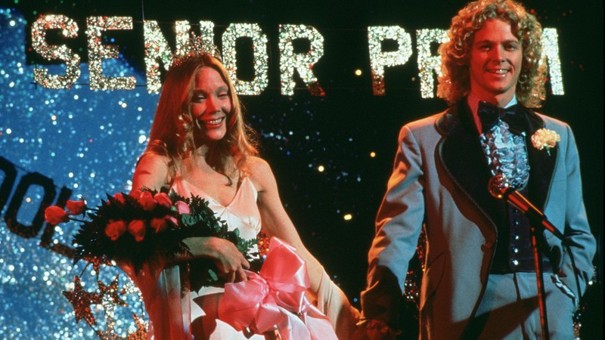
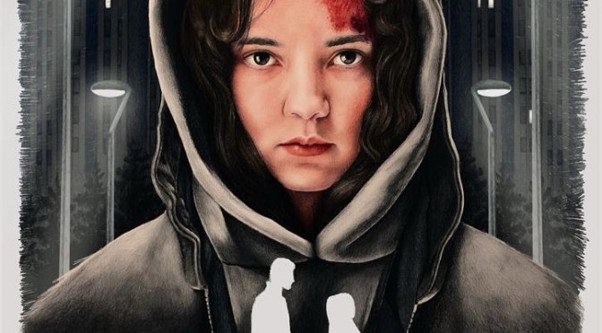
The festival presented the film in a 4K restoration within its Sitges Clàssics section and made its iconic blood-soaked climax the basis of the official poster, created by the agency CHINA with photography by Anne Roig. Amy Irving, who made her screen debut in the film as Sue Snell, received the festival’s Grand Honorary Award and also presented The Fury (1978), also directed by De Palma, in which she plays a young woman with psychic abilities exploited by others.
Italian composer Pino Donaggio, who wrote the music for both films, returned to Sitges. The festival also offered a first look at the new series adaptation of Stephen King’s novel by American director and showrunner Mike Flanagan (for Prime Video), with Summer H. Howell as Carrie White.
Placed side by side, the two 1976 films reveal a shared logic. In both, the young are not monstrous by nature: they become dangerous in response to adults who have failed, humiliated or abandoned them. Serrador’s children take vengeance for the victims of history; Carrie avenges herself against a community and a family that denied her any space. The horror does not reside only in the child but in the mirror the child holds up to the adult world.
The festival extended this dialogue through a small cycle on uncontrollable minds. Scanners (1981) by Canadian director David Cronenberg was screened in the presence of Canadian actor Michael Ironside, and Firestarter (1984) by American director Mark L. Lester, another Stephen King adaptation, recalled the pyrokinetic girl played by Drew Barrymore. Lester was among this year’s recipients of the festival’s Time Machine Award.
At the luminous end of the spectrum, Matilda (1996), directed by and starring Danny DeVito, celebrated its thirtieth anniversary. Its gifted girl confronting a hostile adult world is, in some ways, a comic inversion of Carrie – proof that the motif of the child with extraordinary powers can also produce fable rather than tragedy.
The cycle was complemented by the publication of La mente indómita. Poderes psíquicos, paranoia y cine fantástico (The Untamed Mind: Psychic Powers, Paranoia and Fantastic Cinema), a volume edited by Àngel Sala, director of the festival, and film scholar Jordi Sánchez-Navarro, which examines the representation of mental powers in fantastic cinema before and after 1976.
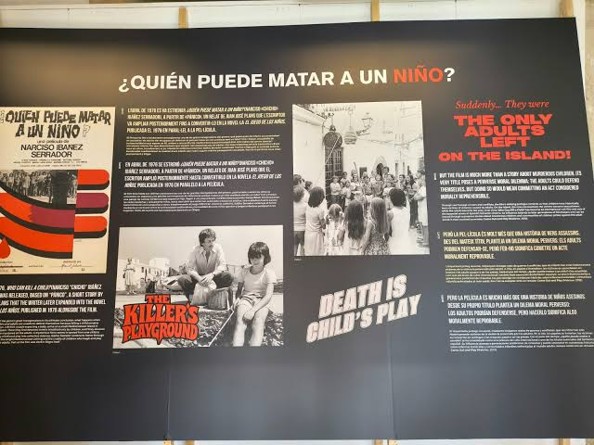
The theme also went beyond the screens. At the Miramar – Centre Cultural, an exhibition titled Solo son niños: 50 años de ¿Quién puede matar a un niño? (They’re Only Children: 50 Years of Who Can Kill a Child?) offered a journey through seven decades of fantastic cinema via the figure of the evil child. Free of charge and open throughout the festival, it explored the archetypes and iconic images that have turned childhood into a source of horror.
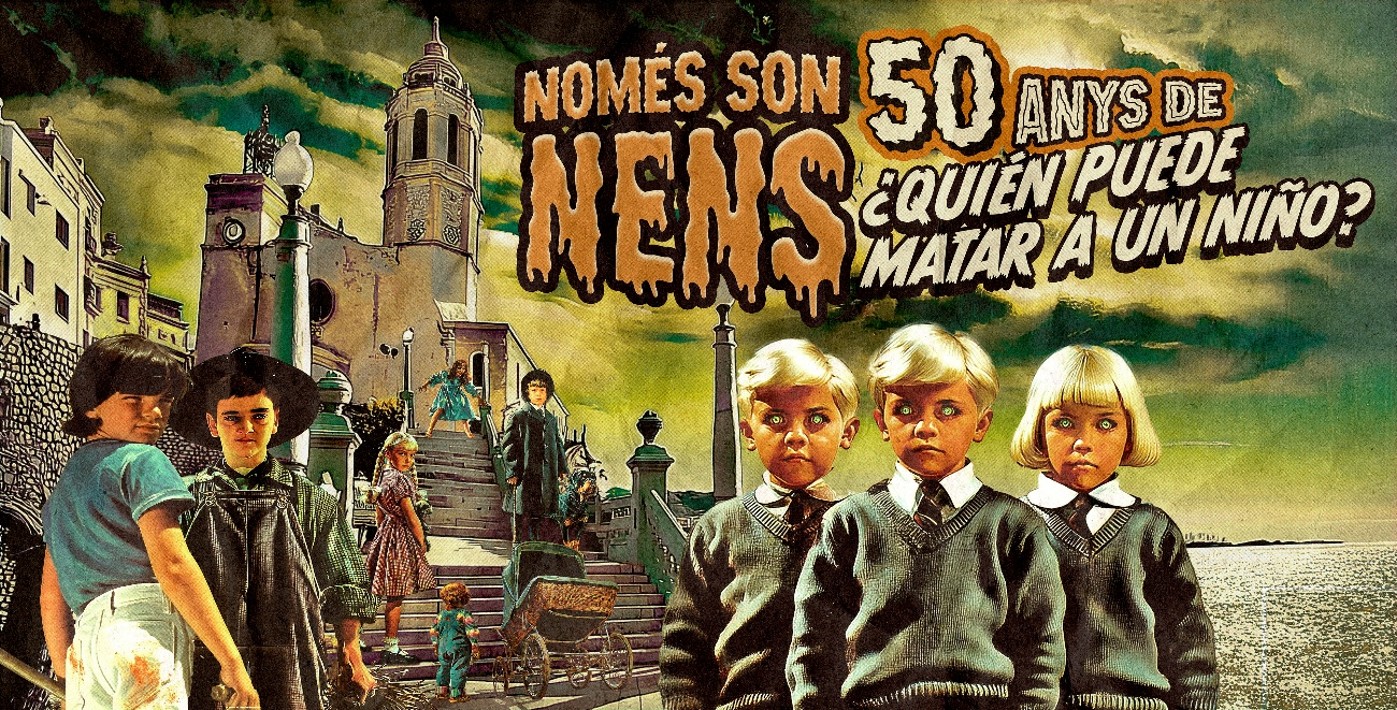
The exhibition’s approach is useful precisely because it frames the figure as a set of recurring archetypes rather than isolated titles: the hostile collective of children, the possessed child, the child as an envoy of evil, the gifted child feared by society. Seen in that sequence, the evil child appears less as a genre trick than as a barometer of each period’s anxieties about family, education, religion and violence.
Two documentaries looked at Serrador’s legacy from a Spanish perspective. In the Sitges Documenta section, El último recreo (2026) by Àngel Sala and Jesús Loniego takes Who Can Kill a Child? as its starting point. La niña del fantaterror (2026) by Jesús Loniego and Aída Cordero portrays child actress Marián Salgado, who worked in key titles of Spanish horror during the country’s transition to democracy, including Demon Witch Child (La endemoniada, 1975) by Spanish director Amando de Ossorio and Serrador’s film.
Together, they recover a chapter of Spanish film history that has often been treated as marginal. They place the child performer, rather than the child character, at the centre of the story. The most interesting question, however, was how contemporary filmmakers revisit the motif.
In the Official Fantàstic Competition, 11 (11, 2026), the first feature by Catalan directors Clàudia Serra and Paula Serra, connects most directly with the leitmotiv. It follows ten scouts aged twelve and thirteen who travel with two young group leaders to a mountain refuge in the Pyrenees and are trapped by a snowstorm. As the situation deteriorates, fear, mistrust and the instinct for survival begin to rewrite the rules of coexistence.
The lineage is clear, from William Golding’s novel Lord of the Flies to Serrador himself, but the Serra sisters shift the source of menace: once fear takes hold, the threat lies less in an external evil than in the fragility of group norms. It is a significant debut, made with Catalan talent in front of and behind the camera, and a timely reminder that the question of what children are capable of is ultimately a question about the communities that shape them.
Several other competition titles approached childhood through parenthood. Nightborn (Yön lapsi, 2026) by Finnish director Hanna Bergholm, also in the Official Selection, observes the newborn as a source of dread from the perspective of an exhausted mother, linking postpartum anxiety with Nordic troll folklore.
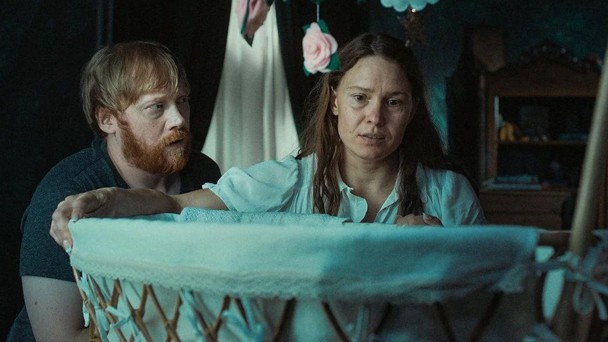
MUTTER: The Diary of a Mother (2026) by director Alphan Eşeli, presents a woman who, after a traumatic birth, decides to protect the non-human creature she has brought into the world. Japanese director Hirokazu Koreeda, whose filmography has always revolved around the family, moved to science fiction with Sheep in the Box (Hako no Naka no Hitsuji, 2026), in which a couple who have lost their son take in a humanoid with the same appearance as the child.
In these films the uncanny child is no longer an enemy to be destroyed, but an extension of parental fear, guilt or grief. The horror has migrated from the child to the adult’s inability to love, accept or let go.
The motif also appeared in the parallel sections. In Hen (2026) by director Nico Scheepers, a couple find a child inside a chest, take him in and discover that he suffers from an inexplicable illness. In La mancha (2026) by Argentine brothers Adrián García Bogliano and Ramiro García Bogliano, a group of teenagers are trapped by a curse inside an amusement park that connects them to another reality.
And in Girl in the Night (2026) by Slovenian director Luka Marčetić, a kleptomaniac and a girl convinced she is a superhero form an unlikely pair in a black comedy that plays with the figure of the exceptional child. The diversity of tones, from survival thriller to body horror, science fiction and comedy, shows how flexible the archetype has become.
What emerges from this edition is a clear evolution. In the classic period, from The Bad Seed to The Omen, the evil child was often presented as an absolute other: a seed of innate wickedness, a demonic intrusion into the family. Who Can Kill a Child? and Carrie already complicated that view in 1976 by making adult violence the origin of the horror.
Fifty years later, most of the new films discussed here take that reversal for granted. Their children are rarely evil in themselves; they are vulnerable, damaged, misunderstood or simply exposed to circumstances that adults cannot control. The fear they generate says more about parenthood, institutions and collective responsibility than about childhood itself.
By pairing two anniversaries, Sitges 2026 did more than celebrate classics. It offered a coherent, multi-layered reading of a genre figure, connecting heritage and new production, screen and exhibition, Spanish film history and international trends.
Serrador’s question, formulated as a provocation in 1976, still resonates because contemporary cinema continues to answer it in new ways. Who can kill a child? Perhaps the more disturbing question, the one this edition kept returning to, is who allowed a child to become frightening in the first place.
Raquel Abad Coll
Edited by Yael Shuv
© FIPRESCI 2026