
Millennium Docs Against Gravity Doesn’t Want to Be the Biggest at Any Cost
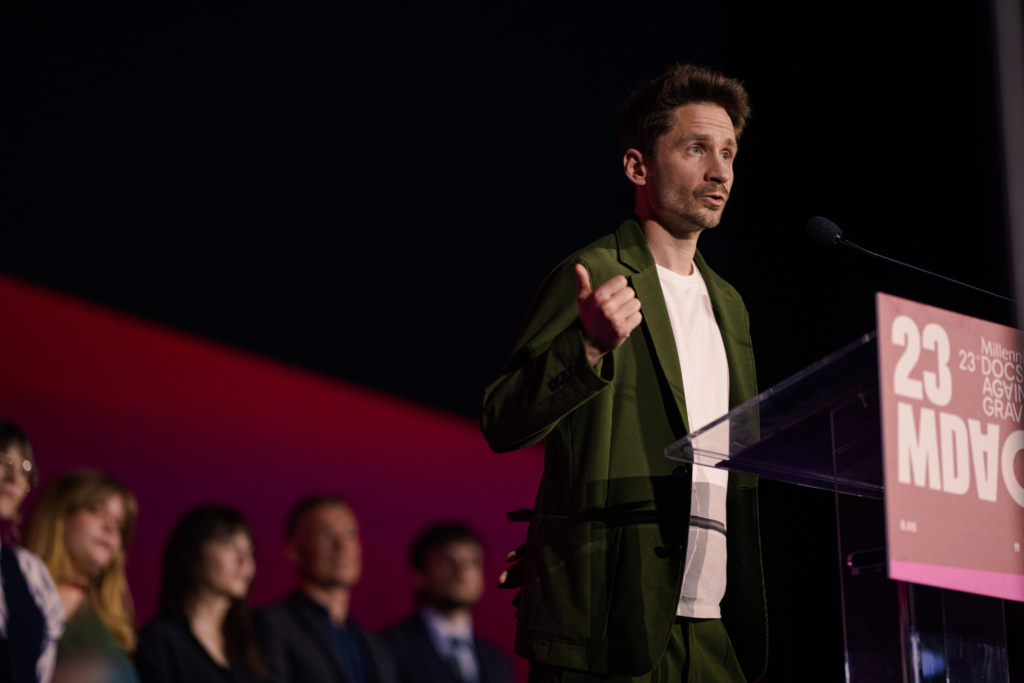
Today one of Europe’s leading documentary film festivals, Millennium Docs Against Gravity has built its reputation not through scale alone, but through careful curation, audience engagement, and a commitment to artistically ambitious nonfiction cinema. In conversation with Polish critic Sylwia Szostak, artistic director Karol Piekarczyk reflects on the festival’s evolution, the changing landscape of documentary filmmaking, and the future of Polish documentary cinema.
Sylwia Szostak: How would you define the identity of Millennium Docs Against Gravity today? What distinguishes MDAG from other documentary film festivals?
Karol Piekarczyk: From the very beginning, the sense of community around the festival has been extremely important to us. Long before Millennium Docs Against Gravity became an event of international scale, we placed enormous emphasis on audience development and building relationships with viewers. We conducted audience research, spoke with participants, and listened closely to their needs so that the festival could become something more than just a film showcase.
For me, the greatest success of Millennium Docs Against Gravity is when someone attends the festival and leaves with the feeling that the overwhelming majority of films were genuinely excellent. I hope these kinds of experiences create a lasting memory of the festival and ensure that documentary cinema remains with audiences well beyond the event itself. We want the festival to be associated above all with quality and a carefully curated programme.
SS: What are MDAG’s biggest ambitions or programme goals for the coming years?
KP: At the moment, we are in the middle of a broader process of evaluation and long-term strategic planning for the future of Millennium Docs Against Gravity. It feels like a natural moment because, in some ways, we have become prisoners of our own success. Every year something significant happens around the festival, the scale of the event keeps growing, and with it grow the expectations of audiences, the industry, and our own ambitions.
At the same time, we are thinking very consciously about future development. Last year the festival attracted around 180,000 viewers across Poland, and today our goal is no longer unlimited growth. We care much more about maintaining the quality of the experience and properly taking care of both audiences and partners. That is why we are cautious about adding new locations or expanding too rapidly — we want to grow responsibly and remain true to the foundations on which MDAG was built.
As we continue to develop the industry section of Millennium Docs Against Gravity, we constantly try to strike a balance between scale and intimacy. We want to create a space where people genuinely have time to get to know one another, talk, and think about potential collaborations. And those collaborations really do happen, including international co-productions.
What does not interest us is a model based solely on fast-paced networking meetings where conversations last only a few minutes before everyone rushes to the next one. We prefer a more quality-oriented approach. If we create a space for collaboration, we want it to be thoughtfully designed and capable of fostering authentic relationships and tangible results.
SS: You speak a lot about audiences — how do you research and understand your viewers?
KP: One of the most important tools helping us understand the audience of Millennium Docs Against Gravity is a very detailed analysis of viewer behaviour. We analyse ticket sales, screening times, interest in specific topics, and how attendance is affected by filmmaker Q&As and accompanying events. After every festival we carefully review all of this data and draw conclusions for future editions.
One important insight from the research was that viewers struggled with what we called the “impossible choice” — situations in which two highly interesting films were screened at the same time, leaving audiences frustrated because choosing one meant missing the other. That was when we consciously decided not to endlessly increase the number of titles in the programme.
Of course, from an audience perspective, 170 or 200 films may sound like a huge number, but in reality it is not that much. Many international festivals of comparable scale screen 300 or 400 films. We deliberately chose a different path: instead of continuously expanding the programme, we prefer increasing the accessibility of individual titles. That is why our films usually receive more screenings than at many other festivals. We received a great deal of positive feedback from viewers who said this made planning their schedules far easier and more comfortable.
SS: Do you currently notice any global trends in documentary cinema, whether formal or thematic?
KP: Documentary cinema is clearly responding to changing social moods and contemporary concerns. For example, a decade ago, ecological and activist films dominated the field — often highly alarmist works about catastrophic climate change and the end of the world. Today, filmmakers still address climate change, but increasingly in different ways: by showing the beauty of the planet and trying to build emotional connections with nature instead of relying solely on catastrophic language.
For several years now, there has also been a strong rise in psychological and therapeutic themes. At Millennium Docs Against Gravity we observe this both in audience attendance and in the popularity of accompanying events. Sections focused on interpersonal relationships, emotions, or mental health consistently attract viewers. Audiences today want not only to watch films, but also to discuss their own experiences and seek spaces for reflection.
There are also themes that remain important regardless of changing trends. We know audiences will always return to music documentaries, socially engaged cinema, and stories concerning human rights. These themes have long formed one of the foundations of documentary cinema and festival audiences.
We also clearly see that audiences increasingly value the “event” aspect of screenings. Viewers are looking for something beyond the film itself. If a screening includes additional value — a conversation with filmmakers, a debate, or a special contextual event — audience interest immediately increases.
SS: How has documentary filmmaking changed under the influence of streaming platforms? Have Netflix or HBO changed the language and structure of contemporary documentaries?
KP: There was a moment when streaming platforms invested heavily in documentary cinema, not only by producing their own titles but also by acquiring finished films from the festival market. Very often platforms enter projects during the final stages of financing, when filmmakers are missing the last funds needed to complete production.
In such situations, directors, producers, or rights owners naturally want to sign quickly because the money is essential to finishing the film. The problem, however, is that this sometimes comes at the expense of the film’s broader life — particularly its festival and theatrical circulation. For a certain period, platforms prioritised putting films online as quickly as possible. It happened quite often that a documentary premiered at a major festival such as the Sundance Film Festival and shortly afterwards appeared on a streaming platform, effectively closing off opportunities for further festival or theatrical screenings.
I do feel, however, that the situation is beginning to change. Filmmakers are becoming better negotiators, and platforms are also starting to understand that festival and theatrical circulation can help films rather than harm them.
This year, our Main Competition included films connected both to Netflix and to National Geographic. And it turned out that the platforms were willing to postpone their streaming release windows in order to allow the films to screen at the festival. Of course, MDAG’s status as an Oscar-qualifying festival helps here, but it also demonstrates that dialogue is possible. Well-managed cooperation between festivals and streamers can benefit all sides involved.
SS: In the selection process, what matters more to you: the relevance of the topic or originality of form?
KP: In the Main Competition, the subject matter is obviously important, but formal and cinematic quality are equally crucial for us. This section is dedicated primarily to artistically outstanding productions — we are looking for formally daring cinema, well-crafted films that offer something beyond simply addressing an important issue.
Within the programming team, we are guided by what sounds like a deceptively simple principle: selecting the best films. Naturally, this involves countless discussions and exchanges of perspectives, because those diverse viewpoints allow us to build the programme more thoughtfully.
In recent years, another context has emerged with the festival’s status as an Oscar-qualifying event. On the one hand, it is a tremendous distinction; on the other, it brings a certain responsibility. We increasingly think about which films have the potential to later gain visibility within the international awards circuit.
We are also interested in productions for which recognition at MDAG could genuinely help their future festival or Oscar trajectory. Sometimes we try to identify films that may not yet be widely discovered but possess enormous potential and need one significant push to gain international attention.
SS: After so many years working with documentary cinema, can anything still completely surprise you as a viewer?
KP: Formally speaking, documentary cinema never stops surprising me. There is hardly a year when I do not encounter a film that makes me think: “This is something entirely new.” And that is exactly what fascinates me about this medium — the constant search for new ways of telling stories.
Sometimes I read descriptions of films presented at other festivals and initially feel that a certain formal device has already been done before. But then I watch the film and realise the filmmakers found a completely new way of using that idea or gave it an entirely different meaning. That, I think, best demonstrates how alive and constantly evolving documentary cinema remains today.
SS: How do you see the work of the new generation of young Polish documentary filmmakers?
KP: For years now, Polish documentary cinema has been in excellent condition. There is hardly a year when Polish titles are absent from major international film festivals, and they often win awards.
I believe the younger generation of Polish documentary filmmakers is truly exceptional. On the one hand, perhaps more than ever before, they understand the international festival market and — most importantly — they understand what audiences are looking for in cinema.
Their films often embody what is best about documentary filmmaking: even when they tell stories that may initially appear deeply local, they place enormous emphasis on the universal dimensions of those narratives. As a result, regardless of where in the world audiences encounter these films, viewers can not only understand the stories being told but also develop a deep emotional connection with the protagonists.
That seemingly simple idea — that we are all human and that our experiences are fundamentally similar regardless of geography — is not always easy to translate into cinematic form. Young Polish directors manage to do this remarkably well.
At the same time, they are also capable of combining that universality with highly distinctive cinematic styles. They often experiment with form and search for new storytelling approaches while carefully matching form to content.
SS: What barriers and challenges do Polish documentary filmmakers face today?
KP: I think the biggest challenge is unquestionably financing. Documentary cinema is simply not supported financially in the same way as fiction filmmaking.
Operating outside the mainstream also has its advantages. Documentary filmmaking remains freer from some of the rigid structures that have, in many ways, fossilised the fiction film industry. Globally, for example, we see significantly more women working in documentary cinema.
Nevertheless, documentaries still require funding to be completed. In Poland the situation is actually better than in many other markets, but producers still have to perform enormous, almost heroic work to secure adequate budgets for their projects.
What gives us hope is that Polish documentary filmmakers are increasingly entering international co-productions, which helps them close financing gaps. Millennium Docs Against Gravity has developed an exceptionally strong industry section. Every year, creators, sales agents, festival representatives, and broadcasters from around the world come to Warsaw.
We create a space where new collaborations can emerge, and we see projects that first found partners during our events later returning as completed films — not only to MDAG, but also to the world’s leading international festivals.
Sylwia Szostak
© FIPRESCI 2026