
On Reclaiming the Future from Dystopia: An Interview with Time and Water Director Sara Dosa
Following Time and Water’s award-winning run at the 23rd edition of the Millennium Docs Against Gravity, director Sara Dosa speaks with FIPRESCI about filmmaking, climate grief, archives, and the search for hope in dystopian times.

“This old woman singing my son to sleep revives a world lost to me until now”, says author Andri Snær Magnason over footage of his infant child gently stirring in a cradle. The chant in question is a rímur, a traditional form of Icelandic song-poetry whose oral transmission has carried stories and memories across centuries. It is also an evocative piece of music that loads the passage with emotional resonance, speaking not only to the inexorable power of time, but also to our responsibility to resist it through acts of preservation.
It is in this light that Time and Water (2026; United States/Iceland), the newest film from documentarian Sara Dosa, emerges as a cinematic rímur. Inspired by Magnason’s similarly titled book, the feature follows Andri’s search for a way to say goodbye both to his beloved grandparents and to the glaciers that help sustain life on Earth. (“Ok is the first glacier to lose its status as a glacier”, reads the plaque memorializing it. “In the next 200 years, all our glaciers are expected to follow the same path. This monument is to acknowledge that we know what is happening and what needs to be done. Only you know if we did it.”)
As Magnason addresses descendants he will never meet, Dosa interweaves archival footage to reveal the beauty of what is at stake. There is still time to act, she reminds us — both through Time and Water and in her conversation with FIPRESCI following the film’s screening at the 23rd edition of Millennium Docs Against Gravity, where it received the Best Editing Award in the Main Competition.
As a documentary filmmaker, how important is the search for aesthetic expression in your work? And in the case of Time and Water, did you have a guiding principle when conceptualizing its form?
Sara Dosa: I’m always most excited when the form and structure of a film can directly engage with, speak to, or uplift the themes themselves. For a story about time and water, that meant finding a structure that was fluid and polytemporal. From the very beginning, we talked about the role of archives in the film. Not only because Andri has this incredible footage spanning generations — starting with his grandparents, who were among the first people to film Iceland’s glaciers — but also because of what archives mean in relation to the film’s themes. Time and Water is about memory, both human memory and the planetary memory encapsulated in glaciers. We had many conversations with my team about how we could work with archives in a way that felt like memory itself, creating an associative aesthetic language.
You had access to a vast amount of archival material. Was there any particular association that immediately stood out when you first began exploring the archives?
SD: We had over fifty hours of footage from Andri’s family, plus an enormous amount of his own material, as well as footage from the Icelandic Historical Archives. What immediately struck me was the gaze of the camera in his grandparents’ filming of glaciers. They always filmed expanses. The glaciers felt endless, reflecting their belief that these landscapes were eternal. Contemporary glacier photography often focuses on terminal faces and melting lines — essentially documenting their deaths. Those images are scientifically crucial, but they are also measurements of disappearance. Andri’s grandparents came from a world before that awareness. Their perspective became a guide for us. To understand a glacier’s death, you first need to feel its life.
You mentioned filming original material on location. What were some of the challenges involved in making a film like Time and Water*?*
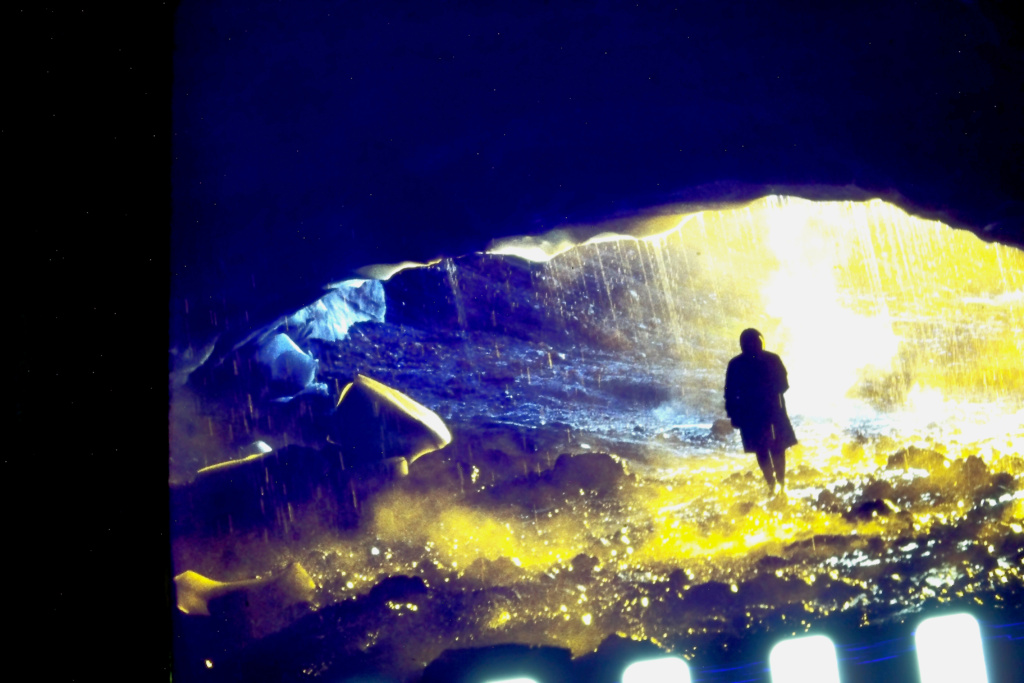
SD: There were many difficulties. We filmed on glaciers during four separate occasions in eastern Iceland, near Vatnajökull, Europe’s largest glacier. We definitely had shot lists, but Iceland’s weather changes minute by minute. One moment there would be a total whiteout, and the next the clouds would part and reveal this surreal golden light. We had to remain open to the beauty and unpredictability of nature itself as a collaborator. We were incredibly fortunate to work with an extraordinary Icelandic crew, and our cinematographer, Pablo Álvarez-Mesa, has an extraordinary sensitivity to landscapes and natural rhythms.
Having National Geographic involved from the very beginning also made an enormous difference. Funding and distributing documentaries has become incredibly difficult, especially films with unconventional structures like this one.
The situation can be bleak for emerging filmmakers. As someone who has achieved considerable success, including an Oscar nomination, what advice would you give young directors?
SD: Trust yourself, but also accept that there’s going to be so much uncertainty. That uncertainty is actually where the magic often comes from. Discovery creates a kind of aliveness in filmmaking. There’s this idea that a director should always have complete control and all the answers, but I think that’s a very rigid and often patriarchal notion of authorship. Collaboration opens things up in meaningful ways.
I worked for years as an assistant, office manager, and associate producer before directing. It was not a linear process. I don’t think I’ll ever feel like I’ve completely “made it,” because filmmaking always remains difficult. But I do feel grateful to continue doing this work with people I deeply trust.
Was there ever a moment during filming when something entirely unexpected felt like a gift from cinema itself?
SD: Yes. In February 2025 we were filming near the glaciers in eastern Iceland. The weather was terrible, and we desperately needed a wide establishing shot. Earlier, Andri had told us about kraftaskald — “power poets” from Icelandic literary tradition whose words could supposedly change the weather. So we started jokingly improvising a weather poem together. And suddenly the clouds parted. The sun emerged and cast this extraordinary golden light across the landscape. Pablo captured this incredible minute-long shot. It felt genuinely magical.
Watching the film, I couldn’t help noticing parallels between glaciers and cinema itself — both preserve memory through time and movement. Did your desire to become a documentarian emerge from a similar awareness of time’s fragility?
SD: I think so. From a relatively young age, I became aware of how fragile human life is. Losing my grandfather, whom I was extremely close to, profoundly shaped that awareness. I remember feeling that the rules of the universe had somehow broken. Film, because it’s a time-based medium, feels uniquely suited to exploring those vast experiences of life, death, and memory. Cinema can create a space where we grapple with things that are otherwise impossible to fully articulate.
Finally, where did your artistic sensibilities and Andri Magnason’s meet?
SD: Andri and I had known each other before this project because he consulted on my earlier Icelandic film, The Seer and the Unseen (2019). When I read his essay “How Do You Say Goodbye to a Glacier?”, I immediately knew I wanted to collaborate with him. His thinking is incredibly expansive and cosmic, but also deeply intimate and playful.
A few years ago, we traveled together to see a volcanic eruption on Iceland’s Reykjanes Peninsula. It became this extraordinary bonding experience — walking for miles while talking about life, death, and nature. Later, once the project was underway, we organized a creative retreat near Okjökull glacier with our producers and editors. Those in-person experiences helped us establish a shared artistic language and a foundation of trust. The entire process remained deeply collaborative from beginning to end.
Bartolomé Armentano
©FIPRESCI 2026