
You Don’t Belong Here: A Romanian Tragedy
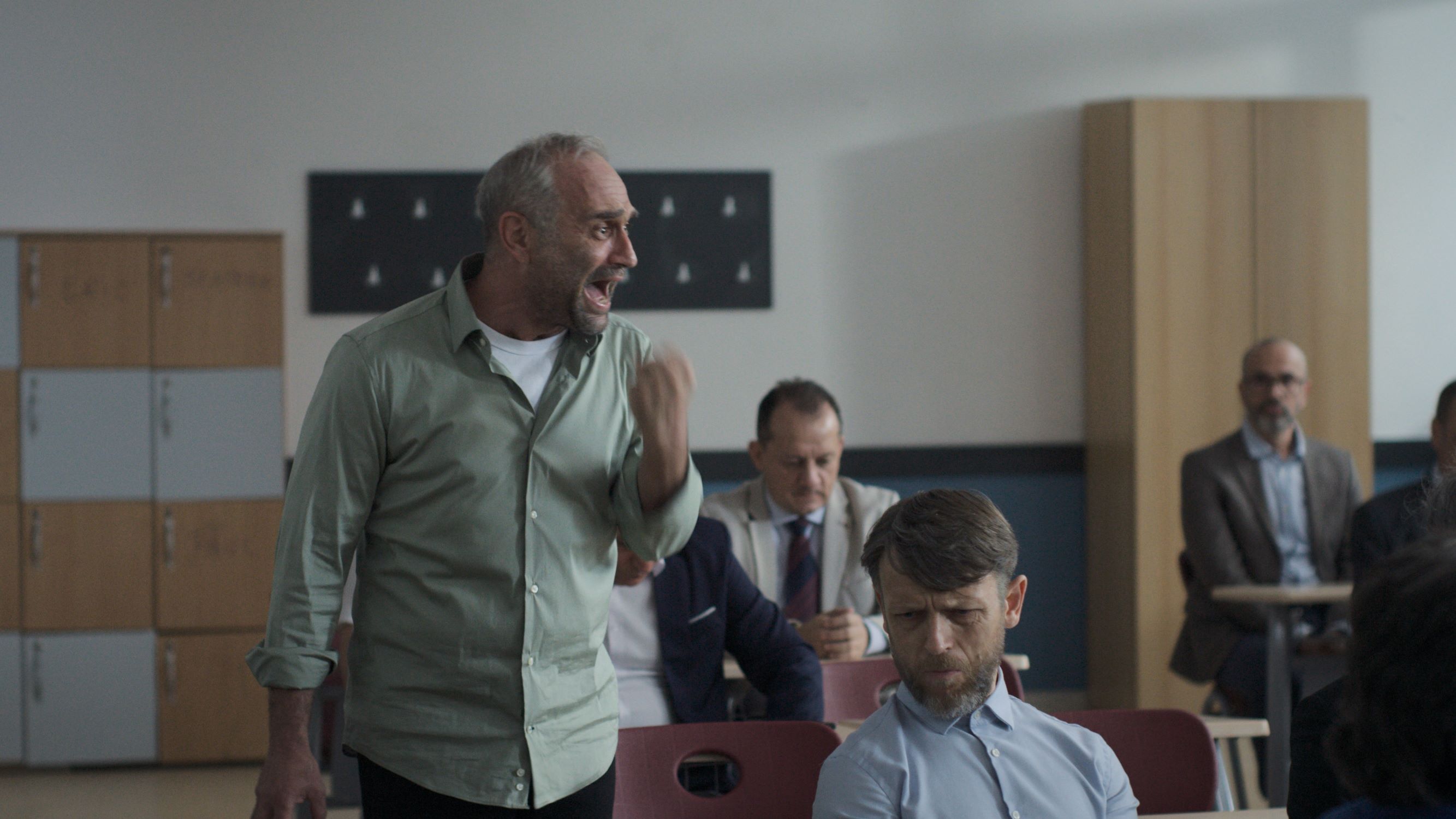
From Locarno, Romanian critic Mihai Fulger reviews the film that took the Grand Prize of the festival, a family drama that becomes a generational portrait, a film that utilizes the trademarks of the Romanian New Cinema but also deviates from them when necessary.
Florin Șerban’s fifth feature, You Don’t Belong Here (Nu e locul tău aici), has instantly emerged as the Romanian filmmaker’s second major triumph on the festival circuit, following his debut feature, If I Want To Whistle, I Whistle (Dacă vreau să fluier, fluier), which garnered two awards at the 2010 Berlinale. Furthermore, You Don’t Belong Here represents the second remarkable international achievement for Romanian cinema in 2026, following Cristian Mungiu’s Fjord, which secured both the Palme d’Or and the FIPRESCI Prize in the Official Competition at the 79th Cannes International Film Festival.
Florin Șerban’s latest film had its world premiere in the main competition of the Locarno Film Festival, where it was awarded the Pardo d’Oro—Grand Prize of the Festival. The young actor Teodor Butănescu, discovered by the director (as was George Piștereanu, the lead of If I Want To Whistle, I Whistle), earned a Special Mention for his performance from the same Concorso Internazionale Jury. The Romanian film also received two awards from independent juries: the Europa Cinemas Label and the First Prize at the Junior Jury Awards.
You Don’t Belong Here begins as an engaging drama exploring the intricate dynamics between parents and children, a theme prevalent in numerous films from the early New Romanian Cinema (such as If I Want To Whistle, I Whistle). The story focuses on Marius Călimănescu, played by the versatile Adrian Văncică in his most compelling film role to date. The nearly fifty-year-old protagonist is a proficient physician, running the largest hospital in his hometown, and has raised his teenage son, Ioan (Teodor Butănescu), alone after his wife’s death. The affection Marius feels for his sole child is difficult to grasp, as their interactions are sparse and lack meaningful conversation. Moreover, the protagonist confides in his mistress that he perceives Ioan as a disappointment, unable to live up to his father’s high expectations.
Marius is caught in a whirlwind of activities: jogging in the morning, spending most of his day working at the hospital, and visiting his lover in the evenings. Amidst this hectic schedule, Marius remains unaware of what his son is doing at night. As the audience learns before the protagonist, Ioan is a member of a gang of masked vigilantes who, under the cover of darkness, vandalize cars illegally parked on sidewalks (even the protagonist’s vehicle, stationed in front of his house, is targeted; in the morning, Marius finds on the windscreen of his car a sticker carrying the menacing message that gives the film its title). Subsequently, it turns out that Ioan’s gang is not only teaching a lesson to the local law-breaking drivers; it is part of a larger neo-Nazi movement, propagating racist, antisemitic, and xenophobic ideas (the alarming recrudescence of such far-right extremist groups, in Romania and beyond, is delicately approached by the director-screenwriter). The revelation that the police suspect his son of involvement in a homicide generates a profound moral crisis for Marius, challenging his proclaimed principles and ethical values.
Florin Șerban gradually and masterfully extrapolates from the father-son conflict to critically examine the first “free” generation, those who came of age following the Romanian Revolution of 1989 and embarked on their journey believing they would change the world. The protagonist’s high school class reunion provides a context to question what has become of that generation’s illusions three decades later.
Not only thematically, but also stylistically, You Don’t Belong Here significantly echoes the New Romanian Cinema formula, which was established in 2005 by Cristi Puiu’s The Death of Mr. Lăzărescu (Moartea domnului Lăzărescu). Extended sequence shots, interior mise-en-scènes skilfully incorporating doors or walls, the general refusal of close-ups or other camera movements aside from the panning required by the characters’ motions, and witty, ironic dialogue are trademarks of the New Romanian Cinema. Notably, the climactic unbroken take of the son confessing to the father is a genuine masterclass in film direction, lighting, focusing, and acting.
Nevertheless, Florin Șerban frequently deviates from the “dogma” of the New Romanian Cinema. When deemed necessary to enhance the film’s impact, the director resorts to the shot-reverse shot or reaction shot (the epilogue scene, for example, employs the most editing cuts), deliberately blurs the image to reflect the protagonist’s confusion, or subtly inserts extradiegetic music. Last but not least, what could be more alien to the New Romanian Cinema than a voice-over monologue (here, used only once, when the protagonist struggles to articulate his deepest thoughts)? You Don’t Belong Here stands out as a thought-provoking cinematic accomplishment that cannot be overlooked.
Mihai Fulger
© FIPRESCI 2026