
Fjord: A Brilliant Modern Drama Between Two Extremes
The winner of the Palme d’Or at Cannes 2026 was also awarded the FIPRESCI Prize in the Official Competition. French critic Renaud Baronian examines Cristian Mungiu’s formidable ability to navigate moral, social, and emotional extremes with extraordinary precision.
To say the least, Fjord was one of the most anticipated films of the 79th edition of the Cannes Film Festival. Its director, Cristian Mungiu, had already been honoured several times at Cannes: the Palme d’Or and the FIPRESCI Award in 2007 for 4 Months, 3 Weeks and 2 Days, and the Best Screenplay Award in 2012 for Beyond the Hills. This is without mentioning the many selections and distinctions his films have received at festivals around the world. A filmmaker deeply engaged with social issues — abortion, religion, politics, class differences — Mungiu has consistently left a strong impression on audiences and critics alike.
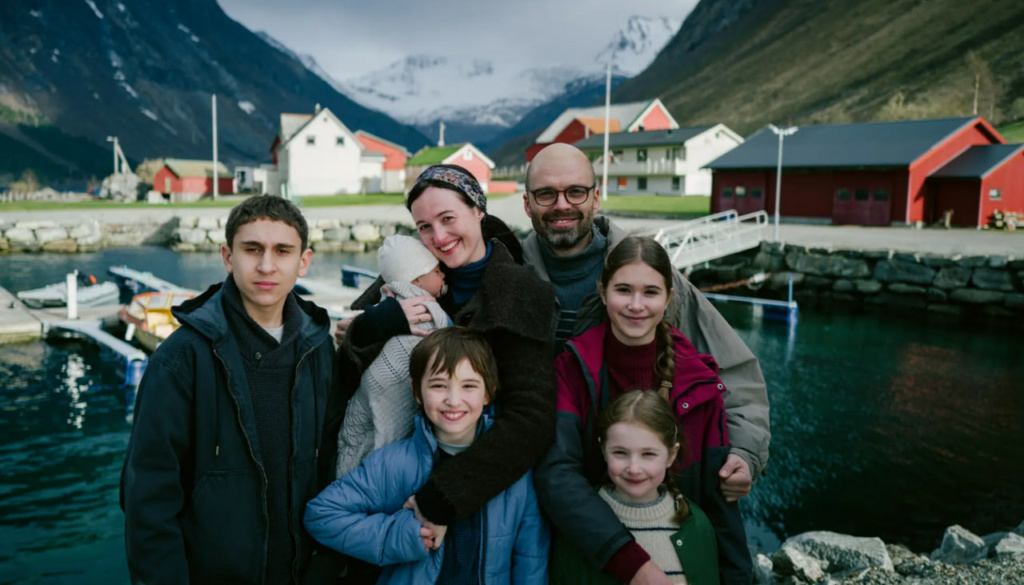
Perhaps one important detail had been forgotten when the festival opened on May 12: beyond being an accomplished screenwriter, an exceptional director of actors, and a remarkable filmmaker, Cristian Mungiu is also extraordinarily intelligent. This is evident in the deliberately misleading information released ahead of the festival: a still image showing a smiling family in front of a picturesque Norwegian village, accompanied by a vague two-line synopsis suggesting that the arrival of this family would disturb the local community.
In reality, the film unfolds very differently — and all the better for it. Mungiu wisely chose not to reveal his plot in advance. A Romanian man, Mihai, and his Norwegian wife, Lisbet, settle with their five children — two teenagers, two younger children, and a baby — in a remote village at the edge of a Norwegian fjord. Deeply religious and ultra-Protestant, they subject their children to a strict moral and religious upbringing. Soon, however, Mihai is suspected of violence toward his children, including corporal punishment. Norway’s powerful Child Welfare Services intervene immediately, removing the children and placing them in foster care, including the infant. What follows is a painful legal and emotional struggle between the family and the authorities, while another drama quietly develops in parallel: the teenage daughter has formed a close bond with a neighbouring girl, and their forced separation becomes one of the film’s deepest emotional wounds.
The screenplay, both rigorously written and masterfully directed, constantly places the viewer between two irreconcilable extremes: ultra-religiosity on one side and an ultra-protective institutional system on the other, where the child’s voice is elevated to unquestionable truth. Mungiu never simplifies the conflict. Instead, he continually forces the audience to hesitate, doubt, and reconsider their own position. The film is filled with moving scenes and subtle hints that suggest darker realities hidden behind appearances, before ultimately returning its focus to the true victims of this moral and legal chaos: the separated teenagers.
Nature itself becomes an essential witness to the story. The breathtaking Norwegian landscapes are far from decorative; the snowy mountains and vast fjords seem to silently observe the madness of human behaviour. At times, nature appears to revolt, most notably in two striking avalanche sequences.
Mungiu’s casting choices are equally inspired. Sebastian Stan and Renate Reinsve deliver extraordinary performances as the couple accused of abuse and torn apart by institutional intervention. Their emotional precision and complete commitment to the material contribute enormously to the power of the film.
By placing itself entirely at the service of its characters and moral complexity, Fjord becomes a work that is simultaneously unsettling, devastating, and profoundly thought-provoking — a dazzling and heartbreaking achievement.
Renaud Baronian
©FIPRESCI 2026