
Queer Masculinity at War: Four Competition Films at Cannes 2026
At Cannes, FIPRESCI jury member Edin Čusto found four Competition films that explored gay male identity through military violence, fascist memory, AIDS, and artistic self-invention.
The 79th Cannes Film Festival arrived with an unusually visible queer presence. The Queer Palm, an independent LGBTQIA+ award created in 2010, considered a record 22 eligible feature films across the Official Selection and parallel sections. Seven were in Competition. Among them, four films directed by and centered on gay men formed an especially striking constellation: Coward by Lukas Dhont, The Black Ball (La bola negra) by Javier Calvo and Javier Ambrossi, Bitter Christmas (Amarga Navidad) by Pedro Almodóvar, and The Man I Love by Ira Sachs.
Taken together, the four films suggested a recurring preoccupation with gay men at war. Sometimes that war was literal, fought with rifles, uniforms, and national myths. Sometimes it was historical, carried through fascism, exile, and queer erasure. Elsewhere, the battlefield moved inward, toward illness, artistic mortality, autofiction, and the ethics of turning other people’s pain into art. The result is an accidental thesis: a Cannes Competition in which gay male experience repeatedly appeared under pressure from history, masculinity, memory, and self-invention.
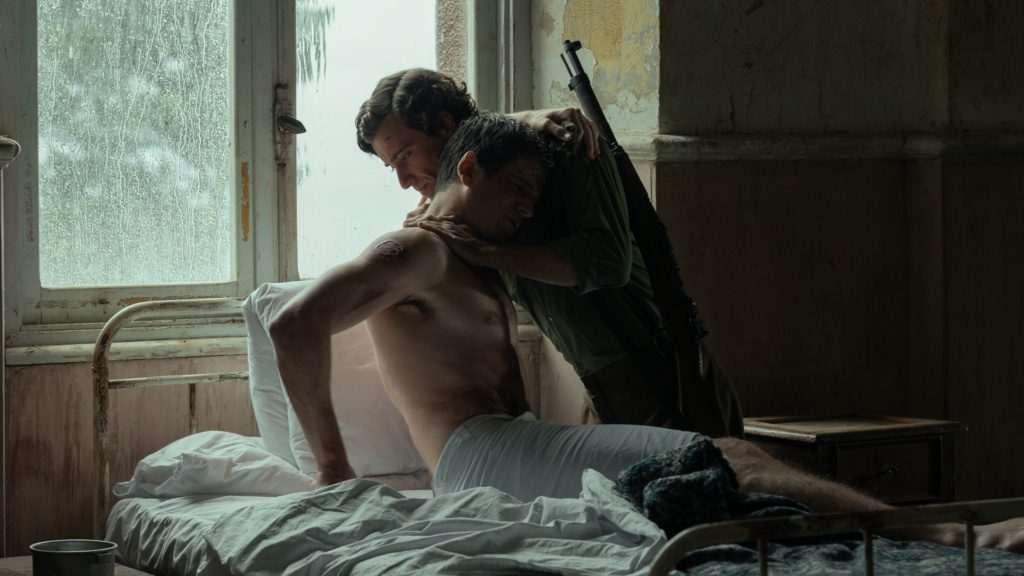
Coward is the most direct case. Set during the First World War, Dhont’s third feature follows Pierre, a young soldier newly arrived at the front, and Francis, a flamboyant tailor whose theatricality briefly provides respite from the camp’s rigid masculine order. Around them, war trains men to obey, suppress fear, and equate endurance with courage. Desertion gives Coward its moral pressure. A man who runs may be afraid, but he may also be refusing the army’s claim over his body. Dhont’s sharpest question is not whether a deserter is brave or cowardly, but why those terms belong so easily to the state and to other men.

Coward links queerness to performance before linking performance to survival. Francis is tolerated when he entertains the troops, when gender play functions as morale, spectacle, or release. But that tolerance has limits. The army can absorb theatrical femininity as a joke or distraction; it cannot permit it as freedom. In that sense, Dhont’s title becomes more than an accusation directed at a frightened soldier or deserter. It names the cruelty of systems that manufacture courage and punish those who fail to perform it convincingly. The tragic machinery may be familiar, but the film’s strongest moments understand war as a force that polices masculinity before it destroys the body.
The Black Ball expands the battlefield across time. Calvo and Ambrossi link three men in three different eras through sexuality, desire, pain, inheritance, and one of Federico García Lorca’s unfinished plays. The historical range moves through Republican Spain, fascist violence, and the present, turning Lorca’s interrupted text into a vessel for queer memory. If Coward examines the army as a present-tense institution of male discipline, The Black Ball considers fascism as an unfinished wound, one that continues to shape the stories queer men inherit and the silences they must work through.
Its relation to war is not only political but artistic. Lorca’s assassination by Francoist forces in 1936 turns the unfinished play into an emblem of cultural violence: a life ended, but also a possible art, language, and future cut short. Calvo and Ambrossi make the fragment feel volatile, passed from hand to hand as desire, testimony, and responsibility. They imagine the ending Lorca never wrote and present the play as completed, turning speculation into an act of queer historical repair. At its most persuasive, The Black Ball understands queer history as both wound and inheritance, carried through beauty as much as grief.
With Bitter Christmas, the war shifts from history to authorship. Almodóvar follows Raúl, a successful screenwriter in creative crisis, who draws on a tragedy affecting one of his closest collaborators while writing his next screenplay. As his invented character Elsa begins to mirror him, the narrative becomes a game of doubles in which autofiction reveals and destroys in equal measure. Here the battlefield is not the nation or the front line, but the page, the screen, and the moral territory between experience and exploitation.

Almodóvar has long treated artifice as emotional truth rather than an escape from truth. In Bitter Christmas, however, the question becomes sharper: how much can an artist take from life before creation begins to resemble theft? Raúl’s crisis is not only writer’s block. It is a confrontation with the parasitic element inside storytelling itself. Saturated interiors, mirrored identities, and theatrical emotional logic turn the artist into both witness and aggressor. He transforms pain into fiction, but the act does not absolve him. It implicates him. In the broader pattern of this Cannes Competition, Bitter Christmas proposes that an artist’s private war can become devastating precisely because he mistakes it for necessity.

The Man I Love brings the argument back to queer male mortality, though in a more restrained and frustrating register. Sachs sets the story in late-1980s New York and follows Jimmy George, a performance artist living between illness and death at the height of the AIDS crisis. Unlike Coward or The Black Ball, The Man I Love does not stage war through armies or fascism. Its war is epidemiological, cultural, and intimate: the war of AIDS, fought against disease, stigma, abandonment, and the disappearance of whole communities of artists, lovers, and friends.
Yet Sachs also reveals the limits of restraint. The central idea is potent: a dying performer rehearsing art while his body and relationships move toward collapse. The rehearsal room should become a site where theatre, gender, desire, and mortality collide. Instead, the pain often remains behind glass. That distance is meaningful up to a point, because AIDS memory can survive as atmosphere, silence, and repetition. But the material also calls for mess, erotic danger, and emotional disorder. In The Man I Love, war has already become memory, and memory has been aestheticized almost to the point of paralysis.
What links these four titles is not only the presence of gay men or queer artists, but their shared return to pressure as a defining condition. Coward and The Black Ball place gay men inside historical systems that turn masculinity into obedience, sacrifice, and punishment. Bitter Christmas and The Man I Love move the conflict inward, toward illness, authorship, and the artist’s uneasy right to transform private damage into form. The pattern is revealing, but also limiting. The Cannes Competition may have made room for gay male experience, yet it often imagined that experience through siege, mortality, or self-destruction.
That is not a dismissal. The wars evoked here are real, and in The Black Ball especially, the connection between queer history and political violence carries undeniable force. But there is also a narrowing effect when gay male life appears most legible through trauma, martyrdom, or aestheticized crisis. The Competition’s recurring image was not liberation, pleasure, or ordinary intimacy, but the body under historical, military, or artistic strain. There is truth in that image. There is also exhaustion.
This is where some of the festival’s other sections felt more refreshing. La Gradiva (dir. Marine Atlan), Flesh and Fuel (Du Fioul dans les artères) (dir. Pierre Le Gall) and Jim Queen (dir. Nicolas Athane and Marco Nguyen) also dealt with queer desire, performance, and the body, but they did not always place gay male experience under the same burden of historical grandeur. Their pleasures were stranger, looser, and less overdetermined. They allowed room for frivolity, erotic absurdity, genre play, or contemporary mess, qualities that can be just as politically meaningful as suffering. Sometimes the more radical gesture is not to give gay men another battlefield, but to let them be vain, funny, horny, confused, unserious, or alive without immediately turning that life into a monument.
Seen from that angle, the Competition offered a strong but partial image of contemporary gay male cinema. Its titles were serious, often ambitious, and frequently moving, but they also revealed how easily prestige cinema returns to queer pain as its most respectable language. Cannes has long made room for boundary-pushing gay male cinema, from Wong Kar-wai’s Happy Together to Xavier Dolan’s Matthias & Maxime. In 2026, the more provocative question was not whether gay men were visible in the Competition. They were. The question was what kinds of gay male life prestige cinema still finds easiest to honor.
Edin Čusto
Edited by Robert Horton
©FIPRESCI 2026