
Fatherland - Where is home?
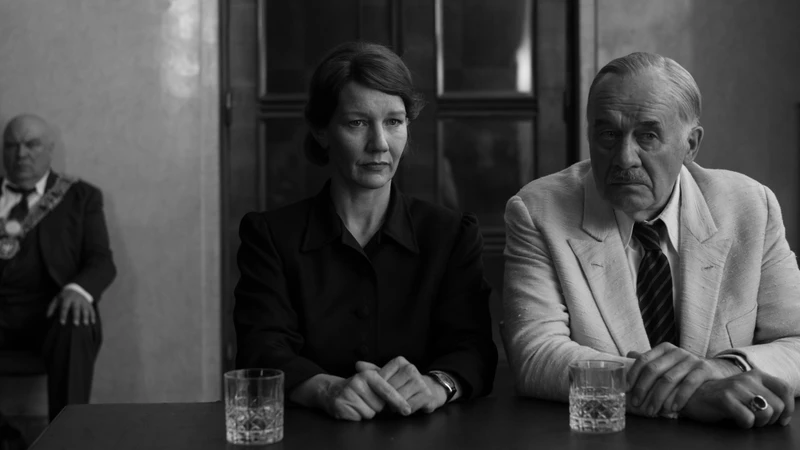
Paweł Pawlikowski was awarded the Best Director prize at Cannes 2026 for his latest historical drama Fatherland. The Polish filmmaker follows the writer Thomas Mann and his daughter Erika on their first journey through Germany after the Second World War. Critic Pamela Jahn takes a closer look at one of the standout films in this year’s main competition.
“You’ve got more clutter than Marlene Dietrich,” says Erika (played brilliantly restrained by the always formidable Sandra Hüller) amused as she unpacks her father’s suitcase. She is accompanying Thomas Mann, the writer and Nobel Prize winner, on his first journey to a divided Germany since the end of the war. Having returned from exile in California, they first visit Frankfurt am Main in the western part, then Weimar in the Russian occupation zone. Mann is receiving the prestigious Goethe Prize in both places. As he revises his speech for the ceremony, Erika takes care of everything else. She is more than just a daughter to her father: she is his assistant, translator and chauffeur. She is also his conscience and his greatest critic.
Meanwhile, Mann’s son Klaus is struggling with depression. He is already in Europe, wasting his time and his father’s money on drugs in Cannes. Soon, an overdose of pills will relieve him of life’s pain – and of a world in which he, the failed artist, is now expected to choose between ‘Stalin or Mickey Mouse’.
In Fatherland, Paweł Pawlikowski brings these two events together: he places Klaus’s suicide – he died on 21 May 1949 – right in the middle of Mann’s return to Germany. The fact that Erika was closer to her brother than any of her other siblings makes the emotional dilemma that father and daughter suddenly find themselves in all the more evident. She mourns Klaus quietly but deeply, asking her father to at least attend the funeral, which her youngest brother Michael is organising. Meanwhile, Mann speaks to an audience of both admirers and critics about the possibility of a ‘good Germany’ in the spirit of Goethe. Cancelling all his important engagements and commitment due to family matters is out of question for him.
At first, the stark black-and-white imagery Pawlikowski applies in his sparsely staged drama seems to emphasise Mann’s emotional coldness. But slowly the effect is reversed: Warmth and a deep sense of compassion between Erika and her father seem possible after all. Fatherland is, in this sense, less a settling of scores than an attempt at a tender declaration of love.
Pawlikowski’s depiction of post-war Germany is less conciliatory. Hanns Zischler in the lead role as the great writer and thinker resembles a battered, incurably wounded superhero, who clearly struggles to come to terms with his home country – or what’s left of it. Living abroad in exile since 1933 has changed Mann’s perspective and sharpened his critical view. A sense of alienation pervades everything, in almost every shot. This feeling of being a stranger in one’s own country is something Pawlikowski has already explored in his earlier films, Ida (2013) and Cold War (2018), both of which are also set in the post-war period and shot in black and white. The fact that Mann never put down new roots in Germany, but instead stayed in Amerika before settling in Switzerland in 1952, is somewhat foreshadowed by this calmly told masterpiece.
Pamela Jahn
© FIPRESCI 2026