
In Karlovy Vary, The Kids Are Not Alright
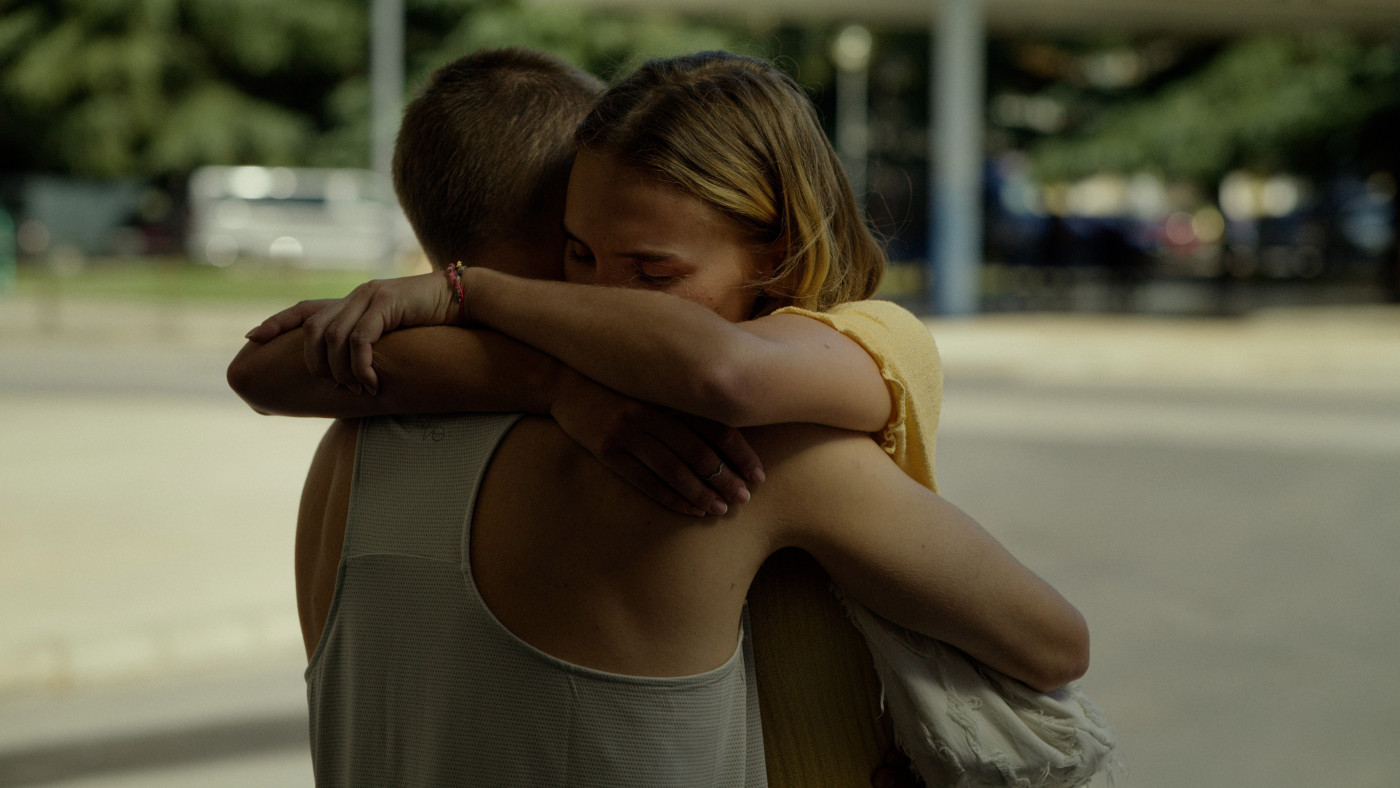
Critic Wellington Almeida observes: The streets of Karlovy Vary buzzed with youthful energy. Inside the cinemas, however, a different picture emerged: young people stranded by broken promises and shrinking futures. Mate Ugrin’s debut feature, Petty Thieves, gave that contradiction its most vivid expression.
Karlovy Vary just closed its 60th edition, an odd milestone for a festival with an 80-year history. That means that for two full decades, the festival simply didn’t happen regularly. Wars, politics—a few years back the world had other things going on. Seeing the town now completely overtaken, you have to wonder what this pastel Czech spa city even does with itself the rest of the year. During these ten days, the place simply surrenders. Everything and everyone seems to function around the festival. Lawn-sleeping students, local kids, young couples, people who dragged themselves from every corner of the country; they take over the colonnades, making the city feel intensely alive.
The funny thing is that a huge chunk of the crowd outside Hotel Thermal couldn’t care less about what is screening in these dark auditoriums. They are not queuing for three-hour East European slow-burners. They are there for the communal buzz, and that, too, is what makes Karlovy Vary’s brand of accessibility so genuinely exciting. It does not demand intellectual submission or cinephile credentials. It simply lets the public hijack high-art cinema’s grandest stage and turn it into an immense open-air block party.
It is a beautiful, temporary suspension of reality. That raw energy on the streets creates a strange friction with what is actually happening on screen. Inside the theaters, it feels as though the films had reached a grim consensus on the current state of the world, attempting to map out a profound disillusionment, diagnosing a European youth (and not only) that has been structurally locked out of its own future.
It is a bitter juxtaposition, watching a generation’s collapse on screen while that exact same generation drinks and sleeps on the grass outside. Though the colonnades might offer them a brief, sunlit refuge, the projections inside insist on delivering the exact financial and emotional invoice waiting for them the moment they head home. Where the streets feel alive, the screen often feels like an autopsy.
Sweep through this year’s lineup and that pattern becomes impossible to ignore, with each director tracking a different stage of a certain generational collapse. Such is the case with Efthimis Kosemund-Sanidis‘s Greek feature A Whole Person Almost (Enas Olokliros Anthropos Schedon), where an unexpected inheritance sets a young man in motion, only to reveal how weakly money can patch up a total lack of certainty. That kind of displacement, on the other hand, turns inward in Shuntaro Uchida‘s Incinerator (Shokyakuro), which follows a pre-teen choked by feelings no one around her has the vocabulary to recognize.
When those suppressed emotions finally explode, they take on the volatile, heat-shock intensity of a film like La Gradiva, French director Marine Atlan‘s extraordinary sophomore feature, fresh off its top prize at Cannes Critics’ Week this year. Set during a high school trip among the ruins of Naples and Pompeii, the film captures desire and cruelty erupting between teenagers with raw, uncalculated force. Against that ancient volcanic landscape, their adolescent impulses hit like a localized disaster; emotional destruction frozen in real time.
That high school trip dynamic takes a much darker, claustrophobic turn in Miroslav Terzić‘s Serbian thriller 3 Weeks After (3 Nedelje Posle). As in La Gradiva, Terzić traps a group of students on a school excursion, but here their journey is abruptly derailed when a highway accident closes the road, forcing them to spend the night stranded in a resort in the middle of nowhere. Inspired by the true story of a student who took his own life after relentless peer persecution by his classmates, the film turns this forced isolation into a pressure cooker. Bullying stops being an isolated act of adolescent malice and reveals itself as the natural language of a brutalized society. Before the world premiere of the film, Terzić took the stage to express his hope that 3 Weeks After might help prevent tragedies like the one that inspired it from “never happening again.”
That sense of violence as something systemic also runs through Nader Saeivar‘s Hijamat, though it migrates from the schoolyard into the private sphere. Following a young gay Muslim man in Berlin cornered by his conservative family, his religion, and his own diaspora community, the film portrays identity not as a proud declaration but as a dangerous secret to be survived.
Across wildly different geographies, the conclusion seems to arrive at the same place: youth no longer feels like a horizon or a beginning. It is simply the moment these characters realize the promises made to previous generations have now expired. The fact that so many films seemed driven by the same impulse to diagnose social reality, as if it had itself become the organizing principle of these films, brought to mind a recent essay by film theorist Pietro Bianchi. In his text, he diagnosed a pervasive sickness in contemporary arthouse cinema: a total surrender of gaze and form in favor of hyper-topical content. For Bianchi, cinema has largely abandoned the idea that its political charge lies in how a story is told, turning instead toward a discursive model where a film’s value is measured by the topical issues it puts on display. Directors are increasingly expected to deliver sociological dossiers on their local realities, reducing complex human and political conditions to a thematic checklist. Today this trend has somehow become the default blueprint for what we now recognize as a “festival film”—works curated less for their, let’s say, cinematic vision than for their legibility as social commentary.
Watching the lineup in Karlovy Vary across its various sections, Bianchi’s words kept ringing in my head. I also miss the days when a film’s politics were defined by their formal radicalism, when camera placement, atmosphere, or a jarring edit were ideological acts in themselves. But sitting in the dark, watching film after film about kids gasping for air, you begin to understand why form has taken a back seat. When collective anxiety reaches this kind of pitch, aesthetic distance starts feeling like some kind of unaffordable luxury. Content has swallowed form because the ground under these characters is burning too fast for composure.
That is precisely why Mate Ugrin‘s debut feature, Petty Thieves (Sitni Lopovi), stood out so starkly among this collection of films. Ugrin is a Croatian filmmaker who studied under Berlin School titans Angela Schanelec and Thomas Arslan, and you can feel that lineage in the film’s spatial patience and its atmospheric weight. But Ugrin doesn’t borrow stylish tricks from his teachers, he uses that formal discipline to solve the exact problem Bianchi diagnosed. Rather than abandoning content for abstract style, Petty Thieves embeds its social-realism tropes—and the concrete issues facing the youth it depicts—directly into its visual and sensory nervous system.
Set against a deceptively idyllic Adriatic resort town, the film follows Rio, a young man navigating a fractured double life. By day, he works in a restaurant and occasionally cruises a gay nude beach. By night, he drifts into small thefts from wealthy tourists, mainly to cover the full-time care required by his sick grandfather. When he meets Andrea, a worker at a luxury hotel who begins joining him on his night runs, their partnership offers a flicker of intimacy, even if it remains fragile and a little unresolved.
While other festival films deliver pre-packaged lectures on structural decay, Petty Thieves lets the decay seep through its textures, relying on physical space and sound design to build its tension. The sun-drenched coast is not just scenery but an engine of alienation, where wealthy tourists consume the landscape and its resources without ever acknowledging the economic decay and emotional erosion experienced by those who actually live there.
The film also flirts with glimpses of magical realism. Recurring, eerie growls of wild boars in the surrounding forest are portrayed not as a threat to Rio but as something closer to a siren call. There is something feral in him, a young man who has opted out of a broken system to live between categories, operating on pure instinct. There is also a distant echo of João Pedro Rodrigues‘s O Fantasma here. Like Rodrigues, Ugrin explores alienation not through abstract policy points but through an intensely sensual, tactile lens where the body completely replaces dialogue. In O Fantasma, Ricardo Meneses’s striking physical presence gave the film its raw, primal force, his body moving through the nocturnal city as if guided by instinct rather than reason. Ugrin finds that exact same physical energy in Gavrilo Jović, the professional dancer making his acting debut as Rio. Jović’s background in movement turns his physical presence into the film’s primary expressive engine, carrying an electric, silent friction through every frame.
What Ugrin captures in Petty Thieves goes far beyond treating identity as a neat, modern label. The film balances its formal control with a grounded, unflinching social realism to show what happens when economic precarity and emotional disconnection strip away the luxury of a future, leaving only desire, stealth, and the instinct of survival in their place. Ugrin does not choose form over reality; he uses formal precision to make the hardships of youth felt in the gut. In doing so, he delivered a special film that does not just tell us the kids are not alright; it lets us feel the exact frequency of their stillness.
And that stillness feels strangely predictive once we return to the spa town where the life of all these films started. Once the projection lights go off, the crowds scatter. That brief illusion of the festival glow vanishes, and Karlovy Vary quietly reverts to its default state: back in the hands of the wealthy visitors strolling past a generation that serves them by day and vanishes into the dark by night.
Wellington Almeida
© FIPRESCI 2026