
Humanity’s Fractured Relation with the Earth: Three Visions from the Proxima Competition at Karlovy Vary
For critic Shiva Fouladi, three films stood out in the Proxima Competition, all on the subject of humans and the environment, which taken together form “a compelling triptych on ecological consciousness in contemporary cinema.”
The Proxima Competition at the Karlovy Vary International Film Festival remains a strong platform for ambitious, formally daring work that blurs the lines between fiction, documentary, and deeper philosophical inquiry. At the 60th edition, three features stand out for their sustained focus on humanity’s troubled bond with the natural world. Axel Bertha’s Against Nature (Contra la Naturaleza), Giovanni C. Lorusso’s Homo Sive Natura, and Yashasvi Juyal’s The Ink-Stained Hand and the Missing Thumb approach this theme from different angles, from alienation and cyclical violence to symbiotic connection and spectral mourning, while bringing fresh formal strategies to slow and hybrid cinema. Each draws on traditions of contemplative observation and dreamlike storytelling without merely imitating them, offering urgent reflections on our shared planetary condition.
Against Nature: Materiality, Silence, and the Echoes of Human Violence
Axel Bertha’s first feature is a rigorously austere yet viscerally immersive portrait of a man’s return to rural Mexico. Jonás, the taciturn protagonist, takes a job as a stonemason in the countryside after years away. Inspired by a real-life incident from local news, Bertha immersed himself in the location for six months prior to filming, working with non-professional local actors and shooting on 35mm under demanding conditions. Radically and astonishingly beautiful, the film favors sensory atmosphere and patient observation over conventional dramatic plotting.
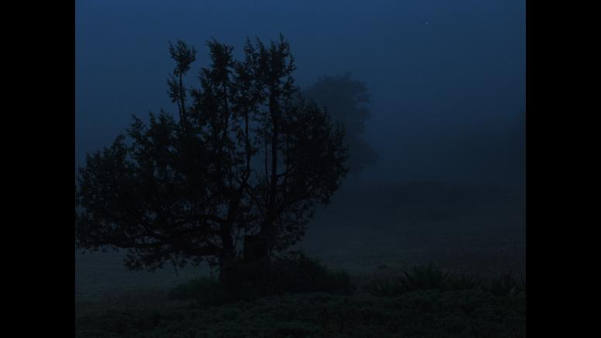
The influence of Carlos Reygadas (one of the co-producers, who assisted the director in post-production stage) is noticeable, but Bertha’s sensibility also recalls Tarkovsky’s ability to play with our conventional notion of time and transform it into something poetic. Long takes linger on elemental forces (rock faces shaped by tools and weather, enveloping mists, hands working stone, human faces thinking, animals), creating images of melancholy grandeur that feel both intimate and vast. These sequences evoke sorrow and awe, conveying the weight of time and the limits of human presence in the landscape. The meticulously layered sound design turns everyday environmental noises into a haunting counterpoint to Jonás’s isolation. The result feels less like a plotted story and more like a phenomenological encounter with place, where the land itself exerts a quiet pressure on body and mind.
Thematically, the film confronts recurring patterns of dominance, extraction, and self-inflicted harm. Jonás carries the residue of larger historical forces, struggling to reconnect. Bertha raises quiet but fundamental questions about whether ideas of progress truly bring us closer to the living world or only increase our estrangement. The narrative moves toward a stark dissolution that feels rooted in the environment’s own logic, suggesting cruelty and conflict are woven into our species’ long relationship with the earth. The project’s commitment to material authenticity (limited film stock, natural light, lived-in performances) strengthens its critique of detachment. The final scene, with snow falling gently on the trees, is one of the most quietly beautiful cinematic moments of the year.
In the broader conversation around environmental crisis, Against Nature offers a meditative counterpoint to stories of mastery or easy redemption. It refuses quick catharsis, instead inviting viewers to sit with our deep alienation and the unknowable opacity of the nonhuman world.
Homo Sive Natura: Reciprocity, Memory, and Resistance in a Forested World
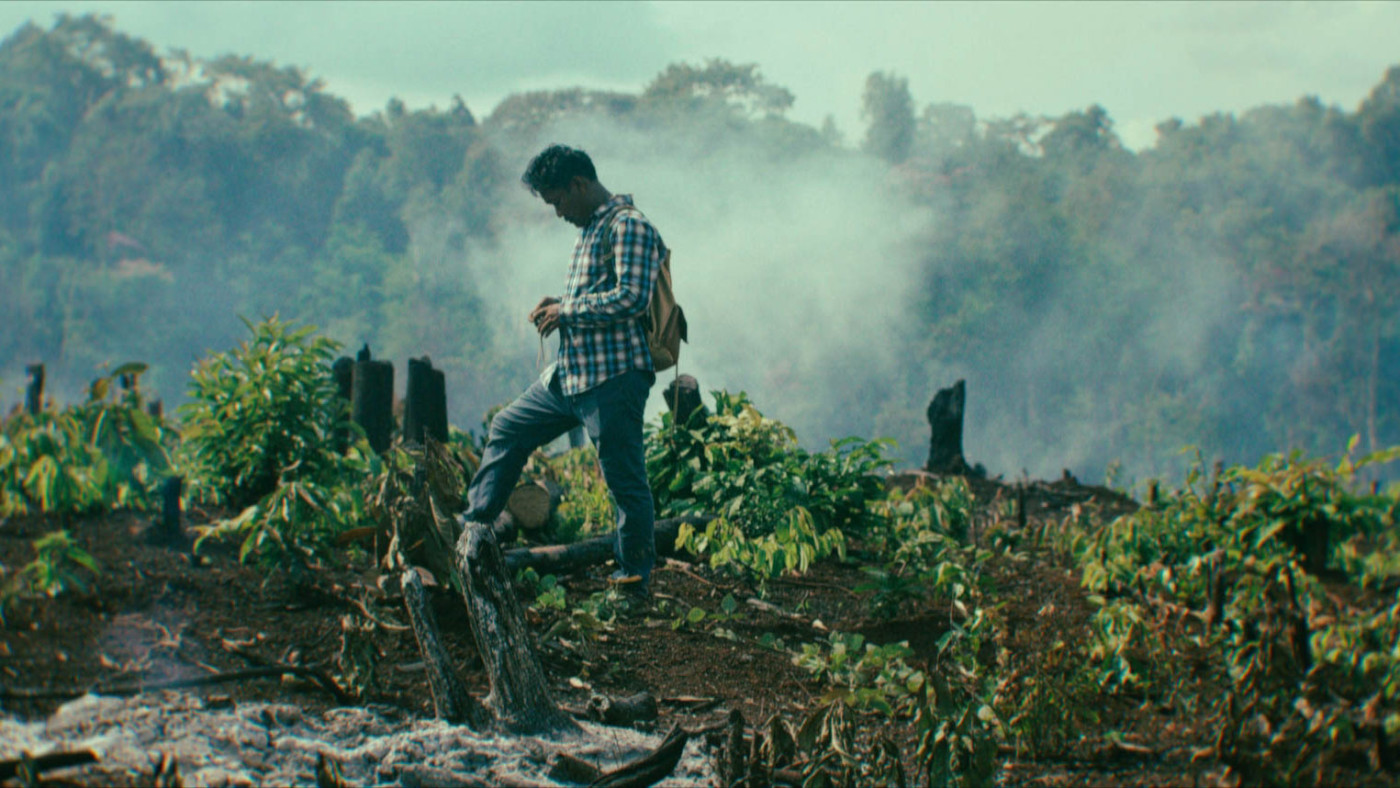
Giovanni C. Lorusso’s Homo Sive Natura shifts focus to the dense woodlands of eastern Cambodia, where an indigenous community maintains a profoundly integrated existence with its surroundings. The Italian director’s work—which is reminiscent, especially at the beginning, of Abbas Kiarostami’s The Wind Will Carry Us, about a man freshly arrived in a new village who frequently speaks on phone with his boss—moves fluidly between observational documentary and subtle reconstruction, capturing both the textures of daily life and the spiritual and cultural bonds linking people to their ecology. Patient camerawork and a rich sound palette evoke the intricate web of rituals, oral knowledge, seasonal cycles, and relationships between humans, plants, animals, and spirits.
The title echoes philosophical traditions that view the human as one element within a larger living continuum rather than its pinnacle. The film presents the community’s way of life as a sophisticated, adaptive system that sustains both cultural continuity and environmental balance. Lorusso avoids romantic idealization, grounding the portrayal in specific practices and voices. The hybrid form works well here: staged moments illuminate emotional and cosmological truths, while documentary passages keep the work anchored in reality.
External pressures like industrial logging, infrastructure projects, and other forms of extraction, threaten these bonds. The film registers these incursions sensitively, showing their impact not only on livelihoods but on entire ways of perceiving the world. The film respects the slower rhythms of its subjects, inviting viewers to attune themselves to tempos that contrast with the rush of globalized development.
Homo Sive Natura adds nuance to decolonial and environmental discussions by affirming the value and fragility of indigenous knowledge systems. It highlights what is lost when these systems erode: parallels between biodiversity decline and the erosion of cultural memory and alternative models of coexistence.
The Ink-Stained Hand and the Missing Thumb: Haunting, Humor, and Transformation
Yashasvi Juyal’s debut feature is set at a highway toll station in the Indian Himalayan foothills, where everyday labor, personal loss, and folklore intertwine in a tender yet unsettling love story. Rajji works at the booth; after her partner Santosh dies in a traffic accident, his presence returns in spectral form. Drawing from the director’s roots in Uttarakhand, the film incorporates real observations of migrant workers, family histories, and the region’s matter-of-fact relationship with the supernatural. Set in the early 2000s, it captures a time when new infrastructure was beginning to reshape older social and environmental landscapes.
Juyal integrates the mundane and the marvelous with lyrical restraint. Humor arises naturally from character interactions and daily absurdities, balancing grief and displacement. The spectral element feels grounded in local beliefs while also symbolizing the persistence of memory amid rapid change. The toll booth itself becomes a potent metaphor for transit, economic pressure, and the human cost of “progress.”
The film shows how an emerging voice can blend social observation with imaginative freedom. The result mourns disappearing worlds while discovering quiet beauty and resilience in the space between memory and the present.
Threads of Connection and Contemporary Relevance
Together, these three Proxima films form a compelling triptych on ecological consciousness in contemporary cinema. Bertha’s work confronts the raw fallout of separation and dominance. Lorusso’s highlights the depth and fragility of reciprocal ways of living. Juyal’s poeticizes the intimate, haunting aftermath of disruption. Each uses duration, hybridity, or magical elements to go beyond surface depiction, deepening our awareness of nonhuman agencies and the long shadows of human activity. In this anniversary festival edition celebrating cinema’s history and present, these films demonstrate the medium’s continued ability to address planetary crises through nuance rather than prescription.
Shiva Fouladi
© FIPRESCI 2026